RAISING HEALTHY CHILDREN
Educators from Carolina Friends School in Durham explore the relationship between health and education.
Carolina Friends School is an independent Quaker school serving students 3-18. Contact the school at:
4809 Friends School Road
Durham, NC 27705
Telephone: (919) 383-6602
www.cfsnc.org
Ruffin Powell joined Carolina Friends School as the Middle School/Upper School Librarian in 2018. She has been a Middle and Upper School librarian since 2002. A Nashville, Tennessee native, she earned her BA in English at the College of William and Mary and her MS in Library Science at UNC-Chapel Hill. After teaching at Culbreth Middle School for four years, she moved north to Rhode Island, and served as Upper School Librarian at Moses Brown, a Quaker school in Providence, for 10 years. Ruffin’s omnivorous curiosity and wonder lead her to many interests, including reading and writing, running, biking, swimming and doing yoga, knitting, cooking and gardening.
By Ruffin Powell, MS
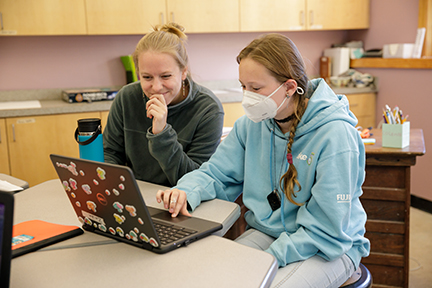
The information available to us right now is vast, and is increasing at an extraordinary rate. According to a PEW research study published last summer, 70 percent of the American adults surveyed said that the spread of misinformation online is a “major threat” to the United States.
As adults, even those of us with the best toolkits for assessing this information can get overwhelmed. Imagine how challenging it can feel for a child, adolescent, teen, or even young adult, who is still developing cognitive skills alongside this unprecedented information access. But we can help them, and ourselves, to harness the usefulness of the information at our fingertips while building critical skills to more readily detect and debunk misinformation.
For my middle school students, I have adapted the six frames of information literacy developed by the Association of College & Research Libraries (ACRL) and distilled them to both a truth and a directive: information is not neutral; and you can combat that by being an active researcher.
Information Is Not Neutral
Information is created with a purpose and for an audience. Different types of information are offered by different types of actors. One of the things I—like librarians globally—am seeing in the students is that they don’t understand the differences between professional journalism and social media. This isn’t simply a generational issue; there are also many elders who don’t have this awareness.

If you treat journalism and social media as all the same, it is easier to be deceived. Instead, we should look at who is offering the information, what they hope to gain, who they are attempting to reach, and why they are using that format or channel. Among social media platforms, there are differences. A blog is a text-based medium, for instance, which is consumed by different people and in different ways than, say, a TikTok.
When I am talking this through with students, I try to give them a personal example. I might ask them to think about a time they messed up. I then ask them to think about how the way they tell that story might change between telling a trusted friend, someone they don’t really know or might not trust, and someone they want to think well of them.
There are outright lies, twisted info, misrepresentations or decontextualizations, and just making noise. It makes it hard to tell what’s real and what’s not. Almost all of it is emotional, which makes our processing more reactive. It turns off our rational processes, making us more vulnerable to untruths.
There are definitely people using social media for advocacy and truth sharing in a positive way. It’s a tool. But there are malefactors, both from within and outside the US, who are manipulating. Identifying content created by those malefactors is tricky and it takes time.
How to Combat Manipulation and Misinformation
That brings us to how you can be an active researcher. I’m going to talk about three different coping strategies for information overload, and how to use them most effectively.
IGNORE IT. One response to the info tsunami is to shut some of it out. Distinguishing signal from noise is always going to be hard. If something is making you really angry or afraid, hand’s up, step back! When your emotions go up, take your hands off the keyboard/screen and put the device down. Come back when you are calm enough to look critically at who is offering this, for what purpose, and in what way. The message may indeed be valuable and merit attention. Or it might not! Deciding what to ignore intentionally is a skill to practice.
INTENTIONALLY CURATE YOUR SOURCES. Another thing to be informed about is who is giving the information. It is extremely useful to build a collection of trustworthy sources or know how to access collections others have built. Is the person or individual speaking from a place of knowledge, authority, expertise, or experience? One method that manipulators use is to gain trust by sharing knowledge in a field of expertise and then using their platform to speak to other areas that they may not be knowledgeable about at all. One major challenge to this tactic is that you may be missing out on critical voices and perspectives that either aren’t on your radar or from which unconscious bias has steered you away.
TIME AND FOCUS: THE GOLD STANDARD. Executive function gets drained when you process information. Don’t go into information gathering or seeking when you’ve been consuming other kinds of content or information. One tried and true method is “lateral reading.” Let’s say you find a piece of information that you are curious about. Open a separate tab/browser and start investigating the source of the information. Then look to see what sources they are citing or referencing—open a separate tab to investigate that. Are they part of professional or other organizations claiming expertise? Open another tab. To keep digging in this way is what it means to read laterally. Another great tactic is to look for alternate sources—is anyone else writing on this topic? What sources are they using?
Helping Children Adopt These Skills
How you help your children to combat misinformation depends a lot on the age of the student and the platforms and technologies that are available to them.
- Build trust with your kids.
- Have open and honest conversations about a range of topics—especially those that are in the news or are locally impactful.
- Model good behavior.
You can start by saying things such as “I was just reading this and wondered where it was coming from,” or “I found this amazing article, and when I dug deeper, I found out it was actually true!” or “I read this from a trusted source recently.” This helps give your children the vocabulary they need to have these conversations honestly. You can also ask your kids what they’ve been reading about at school and what sorts of trusted resources are available to them there. One great way to scaffold these skills is to bring them in as partners in small, age-appropriate ways. Recently, my family needed to buy a new bike rack for my car. I guided my child through the process of how to get trusted information to make this decision: What are the professional reviews saying? Are they compensated for these products? How are the consumer reviews trending on the features that matter to us? Is the one-star review actually about the delivery service and not the bike rack? Is the three-star review applicable to our kind of vehicle? Let them be researchers! You can work together on things that impact the family but that also build the informational skills.