SOUTHERN DERMATOLOGY &
SKIN CANCER CENTER
For more information about skin conditions and their treatment, contact:
SOUTHERN DERMATOLOGY and SKIN CANCER CENTER
An Affiliate of Anne Arundel Dermatology
Gregory J. Wilmoth, MD
Eric D. Challgren, MD
Margaret B. Boyse, MD
Laura D. Briley, MD
Tracey Cloninger, PA-C
Stephanie S. Pascale, MSN, FNP-C
4201 Lake Boone Trail, Suite 200
Raleigh, NC 27607
Telephone: (919) 782-2152
THE SKIN RENEWAL CENTER AT SOUTHERN DERMATOLOGY
4201 Lake Boone Trail, Suite 207
Raleigh, NC 27607
Telephone: (919) 863-0073
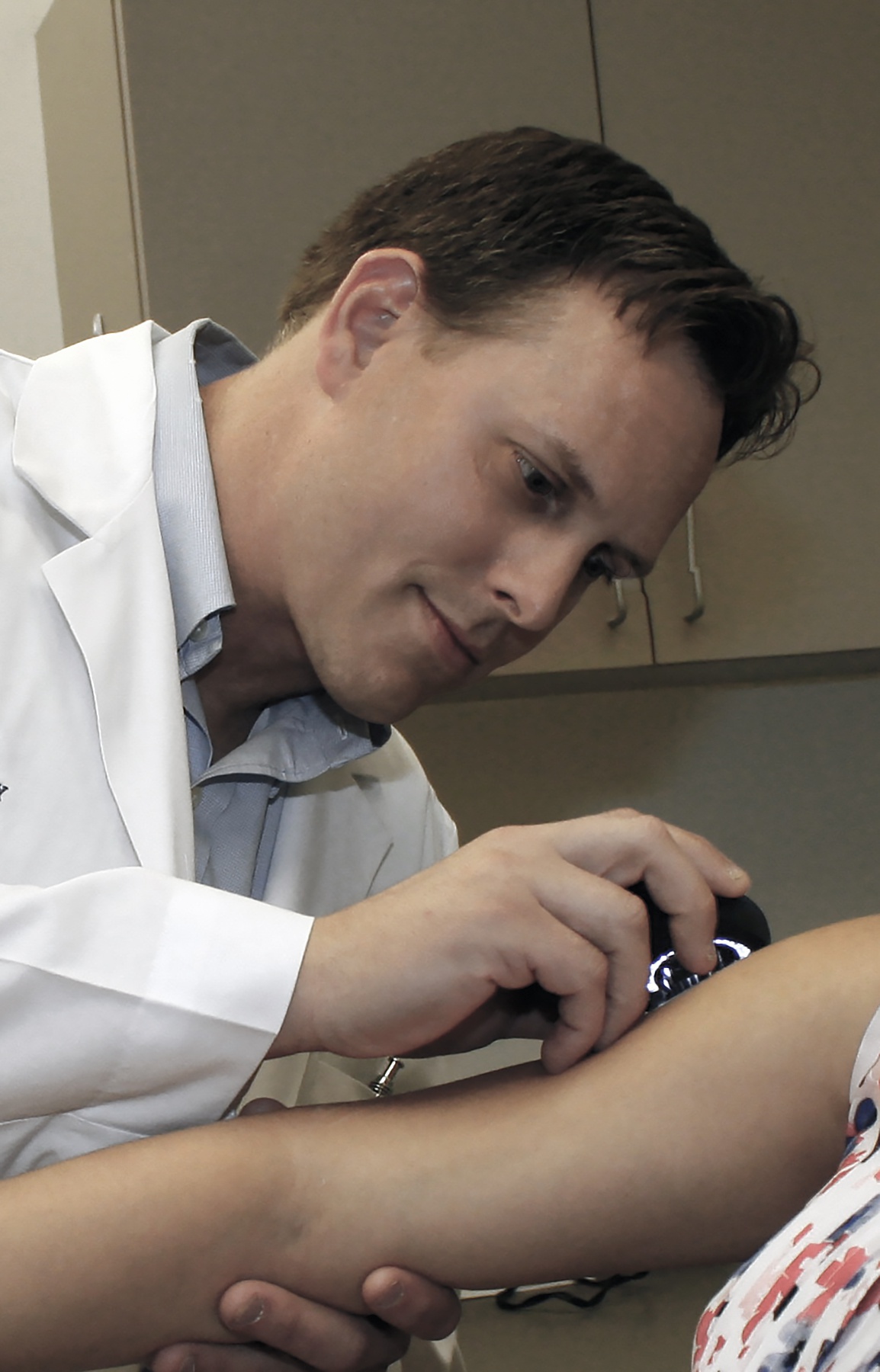
Twenty-five years into his professional journey, Dr. Eric Challgren, of Southern Dermatology & Skin Cancer Center in Raleigh, pauses to reflect on the evolving path of the practice of dermatology and of his own career. “What’s striking to me,” he observes, “is that, for the most part, our work—what we treat—is largely unchanged. What has changed—enormously—is the context in which we treat patients.”
Health&Healing: How would you describe that changing context?
DR. CHALLGREN: I think the changes come from a world shaped by what’s called the digital or information age, and can be summed up in the word “technology.” The impact is enormous—from rapid development of new, transformational medicines to the challenges of practicing medicine alongside “Dr. Google.”
For one thing, the advances in medication are nothing short of revolutionary. This is particularly true for chronic skin conditions such as psoriasis and eczema. The new biologic medications offer these patients enormous improvements in quality of life—relieving most if not all symptoms and greatly reducing side effects.
H&H: Twenty-five years later, how has your experience changed?
DR. CHALLGREN: Happily, what attracted me to dermatology and to this practice hasn’t changed. When I explored options in medical school, I found that I really enjoyed dermatology because of the variety it offered. It allowed me to do pediatric and adult patient care, which I love. It also offered the opportunity to do surgery and—through pathology—to engage in hard basic science. And dermatology is a good fit for another reason: I feel certain my undergraduate training in engineering has made me a more analytical thinker—excellent preparation for the diagnostic work that is so critically important in this field.
Another way of describing what’s important to me in my work is the emphasis on the individual patient. That is such an important part of the way we practice at Southern Dermatology. And the changes that we have seen in the last couple of decades—particularly the targeted medications—are changes that increase our ability to find the right healing path for each individual patient.
H&H: How would you describe those changes?
DR. CHALLGREN: Again, it’s about the tremendous technological advances—especially in medication. The new generations of biologic medications that have come on the market over the last 20 years have transformed the treatment of challenging chronic and auto-immune diseases—such as psoriasis, atopic dermatitis, and eczema—as well as cancer. These medications are custom designed to bind to specific targets in the immune system, basically telling over-active cells to turn off. The result is dramatic improvements in these conditions—often as much as 90 percent better—and very few side effects.
Medication advances have not “cured” the chronic diseases we see most—such as psoriasis and eczema. We’re still managing these illnesses, but your targets have now shifted. If patients come off the medications, the disease state is still present. But, when they’re on the meds, they’re in a state that you can describe as clearance or remission rather than control. For the patients, it’s a huge difference in quality of life. Not only does it mean complete or almost complete symptom relief, but it reduces side effects.
As this trend continues, new, more narrowly targeted medications are offering more precise treatment, and their impact is expanding. So, we now have vastly improved treatments for disease states that, for the previous 30 or 40 years, had very limited options.
H&H: What other technological changes have you witnessed?
DR. CHALLGREN: In the cosmetic world, there have been huge advances since I began my practice. Botox was new then and fillers were just coming on. Today there are numerous anti-aging products and treatment options—including fillers, lasers, and pulsed light therapy—to restore collagen, repair damaged skin, reduce wrinkles, and remove hair, scars, and spider veins,
The technological advances—in medications and treatment tools such as lasers—are tremendous. But I’d have to add that technological changes of other kinds have also had a dramatic impact on our profession and on the way we practice. For example, we live in a world hugely influenced by the Internet and social media and information overload. “Dr. Google’s” advice can be good, bad, or just confusing—but it does influence our patients and certainly plays a role in how we practice.
H&H: Have you seen changes in the conditions that you treat?
DR. CHALLGREN: For the most part, the skin problems we treat are pretty much the same. But a couple of trends are troubling. For example, there has been a steady rise in the incidence of skin cancer—something I would describe as epidemic. This includes melanomas, squamous, and basal cell cancers. Sun exposure is a major culprit, of course, but it is not the only toxic threat to the skin. Exposure to solvents and chemicals, cuts and abrasions, and contact dermatitis play a role.
And that’s related to another trend—we’re seeing many changes in the kinds of toxins that exist in the world, and a resulting increase in skin sensitivities. These toxins are found in everything from pollutants, to processed foods, to the everyday products we use. We live in a global society, and as the world gets more populated and more polluted, our exposure to toxins will not only increase, but will change frequently. This affects health on many levels; dermatology is not immune to that.
H&H: What’s next?
DR. CHALLGREN: There’s no question that the development of targeted, individual therapies will continue—and accelerate. That’s already happening. So as the science and research develop—including more understanding of genetic factors—you’re bound to see newer targeted therapies for many more disease states.
That said, we can’t ignore the cumbersome, bureaucratic nature of America’s health care system. We are blessed with many treatment options; awesome new medications; and better and better understanding of how to treat chronic skin diseases. These give us wonderful flexibility to find the solution for an individual patient’s problem. But just as the healing options have increased, so have the bureaucratic barriers. So, looking ahead, I wonder if it will be more of the same or if we’ll find better solutions for delivering health care.
I’m especially curious about the impact that artificial intelligence (AI) will have over the next 10 or 20 years. AI’s impact certainly involves how quickly we process information. So, I expect it will speed up diagnostic processes and drug development. And that will, in turn, increase the early detection of diseases, especially cancer. Many changes on the horizon!