AGING CARE MATTERS
For more information, contact:
AGING CARE MATTERS
Comprehensive Care Management Services for Aging Adults • Monthly Care Programs • Adult Day Care
3309 Rogers Road, Suite 117
Wake Forest, NC 27587
Telephone: (919) 525-6464
Admin@AgingCareMatters.com
www.AgingCareMatters.com
ADULT DAY CARE CENTERS
Our Centers are open Monday through Friday, from 7:30 am to 5:30 pm.
Our Centers are closed on the following holidays: Independence Day, Labor Day, Thanksgiving Day, Thanksgiving Friday, Christmas Eve, Christmas Day, and
New Year’s Day.
WAKE FOREST ADULT DAY CARE
3309 Rogers Road, Suite 117
Wake Forest, NC 27587
Telephone: (919) 525-6464
Admin@AgingCareMatters.com
www.AgingCareMatters.com
DURHAM ADULT DAY CARE
249 Highway 54, Suite 100-B
Southpoint Professional Center
Durham, NC 27713
Telephone: (919) 525-6464
www.AgingCareMatters.com
GOLDEN HORIZONS ADULT DAY CARE
1106 Hillandale Road, Suite C
Durham, NC 27705
Telephone: (919) 266-4489
www.GoldenHorizonsAdultDayCare.com
“Aging is a process, not an event,” observes Carla Payne, founder of Aging Care Matters, a company that provides care management services and adult day care in the Triangle. “You don’t just wake up one day and become old; it’s a process. Change—physical and mental—is gradual; alterations in lifestyle, relationships, needs, and resources all affect how we age.
“And changes in circumstances can be transformational. A spouse may die, family members may move away, an accident or new health issue may occur. All these contribute to changes in how we experience our lives as we age and how we function and cope.”
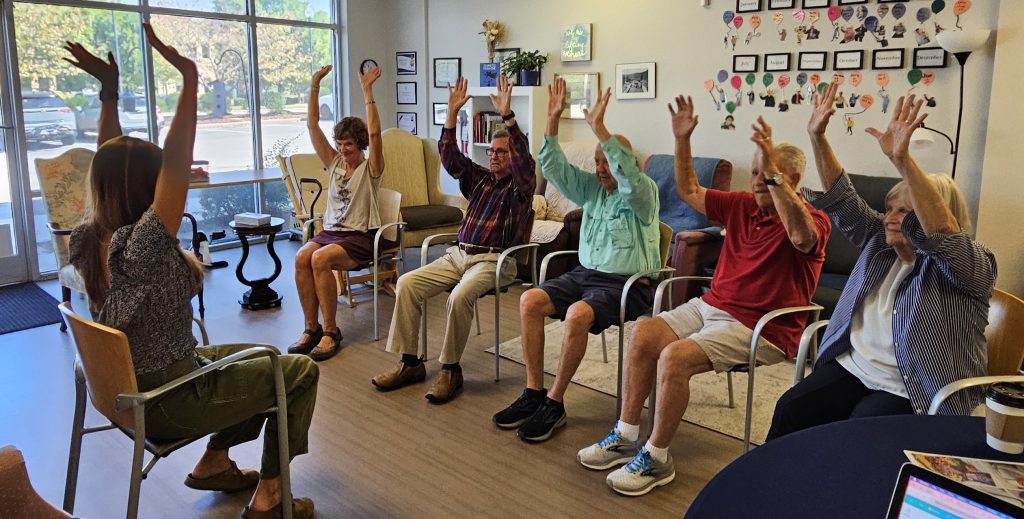
Exercise at Adult Day Care? Absolutely!
“There is no argument,” says Ms. Payne, “about the fact that, whether you’re eight or eighty, you need to keep moving—mentally and physically. Your health and well-being depend on it. And that is one of the foundational principles in our adult day care programs.
“In fact, we have an unofficial motto coined by one of our day care participants, who proclaims every time we go on our walks: ‘A body in motion stays in motion.’
“At the same time,” acknowledges Ms. Payne, “the eight-year-old and the eighty-year-old are most likely to get their exercise in very different ways. In all our centers, opportunities for physical activity are built into daily routines, and always designed so that each person can participate as they are able. These activities include outdoor walks whenever possible, and indoor activities ranging from games and chair yoga to dancing.” And, she adds, “we’re not only committed to ensuring that there are opportunities for moving your body, but also for moving your mind. Consequently, many of our scheduled activities are designed to stimulate conversation and personal connections as well as physical activity, thus strengthening a sense of community. This is critically important, since social isolation and loneliness are major factors contributing to both mental and physical health issues—at any age, but especially as we get older.”
Naturally, she adds, “the need for support varies as well as we go through such transitions. Sometimes the need for support is minimal; sometimes— especially in times of crisis—it can be enormous, and overwhelming.”
“Aging Care Matters was founded to help people understand, navigate, and manage the support they need—at all stages of their aging,” explains Ms.
Payne. “And I like to think of the care manager as a guide through the complex maze that is our elder care system.”
In a conversation with Health&Healing, Ms. Payne describes the guidance offered by the care managers at Aging Care Matters.
The Care Manager: Your Guide
Through the Elder Care Labyrinth
Health&Healing: What does a care manager do?
MS. PAYNE: To understand that, you have to understand what we’re dealing with. Unfortunately, the elder care system is not so much a “system” as a collection of programs and services that are not connected and can be confusing. Navigating that “system” is challenging!
So, that’s what care management is all about. You could describe the job of care manager as a mediator, a coordinator, a facilitator—we wear all of those hats. I prefer the title of “puzzle master,” because the world of elder care is most certainly a large, complex puzzle.
Everything in our system is compartmentalized—and no one looks beyond what’s in front of them. Your family physician, cardiologist, and rheumatologist may or may not be communicating. And when disease or accident takes you into the hospital system, it gets worse. The ER staff will stop what’s bleeding or fix what’s broken. Then the hospital will focus on getting you ready to be discharged. When discharged to rehab, the focus
shifts to meeting very specific goals: walking 50 feet or going to the bathroom unassisted. Then, when you get home, you’re on your own.
Once you get home, the questions pile up: Do I need home care? Physical therapy? Occupational therapy? What about food services, counseling, support groups? Is the care I need covered by insurance? If not, but I still need care, is that sustainable? These and many more questions arise when trying to determine home care needs and options.
When the time comes to move out of the home, you face the next round of questions and issues. What are the legal issues to be addressed? What about insurance and financial concerns? What’s the best next step, and what are my options: Independent living? Assisted living? Memory care? Skilled nursing care? Just mastering the vocabulary is a challenge!
Those questions are just a sample of the many puzzle pieces making up the elder care system. And because care managers understand the big picture, they are able to put the pieces together to meet the needs of individual clients. By helping clients and their families understand the options available to them, care managers prepare them for the big decisions they face.
Care Management Services
H&H: What kinds of services do you offer?
MS. PAYNE: Remember: aging is a process—it’s a journey really. And that journey is a unique experience for each us. So, the care management and
support services we offer reflect that incredibly varied experience. We want to provide what’s needed when it’s needed, supporting clients wherever they happen to be on their very personal journeys. We can help with many things, or just a few, stepping in as needed at different stages of the aging process.
Assessment and care planning services are a typical starting place. This can mean helping clients to identify and connect to home care services they need or providing information about federal and state support programs. For some clients, medical management services are what is most needed. In those cases, we arrange and attend medical and therapy appointments and other health care providers, and facilitate communications between providers, the client, and their family members.
Some clients simply need support with the day-to-day issues in their lives— from paying bills or personal care to finding social and recreational opportunities or communicating with family and friends.
As the aging journey progresses, people often need help evaluating more intensive care needs and residential options, such as assisted living or skilled nursing care. The financial issues related to these choices are often complicated, and we help navigate these as well.
Emergencies are bound to happen, and when they do, we can provide crisis intervention services to organize and manage hospitalizations, rehabilitation stays, and in-home health care.
This is a long list. But remember: you don’t need to know exactly what support you need or want! That’s my job as a care manager. My first responsibility is to get to know you, and to understand your needs and concerns. Next, my job is not only to let you know all your options, but to advise you—knowing you—about what path you might take, and help you decide what support you need. You’re not on your own!
There are no set plans. I can provide a few services or many. It depends on need. I tell folks to give me at least a couple hours of consulting time. I need to know everything; and then I can offer recommendations.
Monthly Care Programs
H&H: In addition to your consulting and advisory services, what other programs do you offer?
MS. PAYNE: We offer more hands-on support for some clients. And these can be especially helpful for those who don’t have family nearby to help oversee their care. Our Care Visits program, for example, is a monthly subscription that includes weekly calls, a monthly one-on-one visit, and access to a care manager. Our Care Calls Program is designed to ensure consistent communication between the client’s loved ones and our care management team. We have a number of clients for example, whose children live outside of North Carolina and are part of their parents’ care team. The Calls program involves regular check-in calls to the client and reports to the family care team.
Private Care Management
H&H: Aging Care Matters is a Private Care Management Service, how does what you do differ from the management services provided through a hospital or employee assistance program?
MS. PAYNE: Two things come quickly to mind: our flexibility and our ability to meet the individual needs of each client. It’s one thing to list the various care management services we provide, but until you need those services, you may not appreciate what you might need and when you might need it. That’s because everyone’s situation is unique, and changes over time.
Sometimes what we provide is simply administrative assistance—helping clients understand their options and the steps they need to take to address insurance or financial issues. Other cases require very different forms of assistance.
A recent example illustrates this. We were called in to help arrange immediate support services for the 80-year-old wife of one of our day care participants (who I’ll call Suzy). Two falls and trips to the ER in 48-hours left Suzy needing 24/7 care for her basic needs, as well as equipment—a hospital bed, a bedside commode, a wheelchair, and a walker. But authorizations for this assistance were held up pending a doctor’s appointment that was still a week away.
Although her hospital care managers were working to help her, they weren’t able to move quickly enough to meet her needs. Happily, we were able to do so. In 24 hours, we got her the bed, the walker, the wheelchair, and the bedside commode for free, and made arrangements for a 24/7 aide to start the next morning. Why were we able to move things more quickly than the hospital staff? It’s the nature of the system. Institutional care managers—working in hospitals or employee assistance programs—typically have large case loads and are constrained by the administrative requirements of the system in which they work. As a private care manager, I have more flexibility and, most important, I’m able to connect regularly and directly with the many resources in the community—the kind of contacts that enabled us to move quickly and efficiently to meet Suzy’s needs.