CYNTHIA GREGG, MD
FACE & BODY SPECIALISTS
For more information about the practice, contact:
CYNTHIA GREGG, MD, FACS
FACE & BODY SPECIALISTS
Cynthia Gregg, MD, FACS
3550 NW Cary Parkway
Suite 100
Cary, NC 27513
Telephone: (919) 297-0097
https://cynthiagreggmd.com

Dr. Cynthia Gregg, of Cynthia Gregg, MD Face & Body Specialists often describes facial plastic surgery as “millimeter surgery.” The important thing to understand about facial plastic surgery, she explains, “is that little changes—small movements of tissue—can make a very big difference.
“That shouldn’t be surprising,” she adds with a smile. “The changes we experience as we age are all about movement. Basically, as we age, we deflate and we descend. Thinning skin, loss of fat and bone, muscle changes, and—perhaps most important—gravity will cause our tissues to descend. And, as things shift and move, they also deflate—we lose volume. These changes can be accelerated by other factors, such as hormonal changes—particularly during menopause—excessive sun exposure, smoking, and, of course, stress. The changes themselves are small and gradual. Over time their impact can be enormous.
“So, the aesthetic surgery we do,” says Dr. Gregg, “is also about movement—adjusting tissues to correct for the sagging and stretching that comes with age, and to address body and facial imbalances.”
Restoring Sagging Tissue
“The aging process happens naturally to all of us,” she says, “but the point where it starts to bother us is, I think, unique to each individual. And the process of reversing the effects of aging varies enormously, reflecting the unique needs and goals of each patient.
“So the first step of this process is to hand the patient a mirror and ask ‘What brought you here today? What bothers you the most? What would you most like to change, and in what way?’
“The response is often a specific feature: women will frequently say they ‘hate their neck;’ many complain of looking tired. But I see these problems in terms of those two fundamental issues: tissue descent and deflation. And we have many options for restoring volume and moving tissue back to where it used to be.”
First steps in the process typically focus on restoring volume, says Dr. Gregg. “Often very minor, non-surgical options will reinflate facial tissue, which is rejuvenating and will eliminate creases. This is done with fillers (see below)—again in very small amounts; every syringe of filler is about a teaspoon. Nonetheless, the anti-aging improvements with fillers are considerable. And for many people, replacing volume in this way is all they need or want.
“However, you may to the point where you’ve deflated so much and have drooped so much that just reinflating will not be the answer,” says Dr. Gregg. “That’s when we get into surgical options—which are variations on what is commonly considered a face lift.
“The surgical approach I take depends on what I need to lift,” she says. “I’ve got skin to deal with and muscle to deal with. Fat pads may have atrophied and dropped, and there may be loss of bone. In a face lift I’m moving soft tissue; I can help with bone loss by putting an implant in. An implant is a form of reinflation; the rest of surgery really is about shifting and movement of tissues back to where it came from.”
A midface lift, explains Dr. Gregg, involves moving fat. “The apple of your cheek tends to drop down by the side of the mouth, and that contributes to that jowly appearance. And all I’m doing in a midface lift is grabbing that fat and moving it back up; I’m not moving skin at all.
“With the middle part of a lower face lift, I’m dealing with muscles and soft tissues that have drooped—pulled by gravity down away from the ear—and need to be shifted back up. Below that, when the jaw and neck are involved, it’s a matter of muscle movement and skin laxity.
“So, in what’s considered a classic face lift, I’m shifting fat back upward to where it used to be; then I’m shifting muscle and some soft tissue back up where they used to be; and finally I’m shifting and removing excess skin. In short, a face lift is all about movement.” The challenge—always—says Dr. Gregg, is to move the tissues back to where they belong and restore volume in a way that avoids that “pulled” look. “The result should be natural—simply restoring what was.”
A Face Lift Unique
to Each Patient
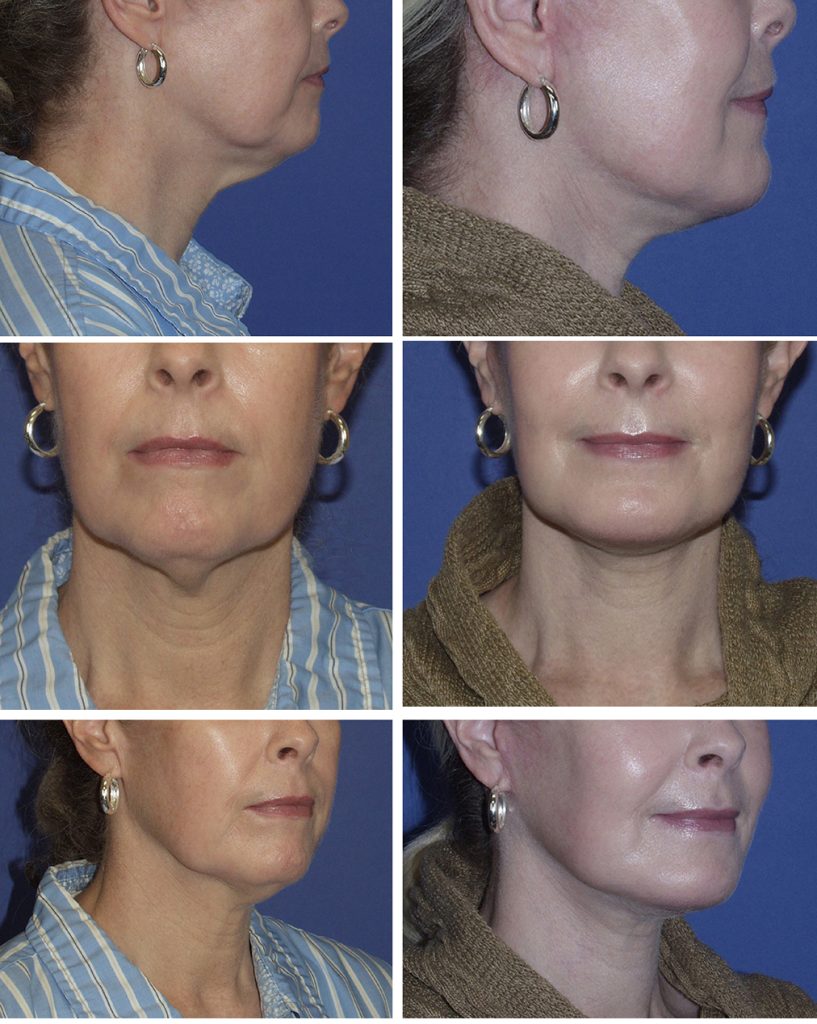
Katherine is a classic example of what Dr. Gregg might call a ‘typical-but-unique’ face lift. While a singular problem motivated her to seek surgery, the approach taken involved several different processes to address sagging skin and loss of volume.
Katherine’s initial complaint was a common one: “I had lost a lot of weight,” she says, “and I had what my mother called a ‘turkey neck’ underneath my chin. It had bothered me for a few years.”
“We hear that complaint very often,” says Dr. Gregg. “And we certainly addressed it. However, in Katherine’s case, the sagging of skin and tissue that was so evident in her neck was also an issue around her eyes and jowls. So, her face lift also involved eyelid surgery (blepharoplasty) and an implant.
“The implant—known as a prejowl implant—is helpful for women who have lost a lot of bone volume on either side of their chin that results in sagging of the jowls,” explains Dr. Gregg. “It’s a surgical form of reinflation, as the volume of the implant lifts the prejowl area and restores the definition to the jawline.”
For Katherine, the surgical plan met all her expectations. “The most important thing,” she says, “was to get rid of all the extra skin of my ‘turkey neck’—which it did completely. What I had not realized before was how other issues were affecting me. Dr. Gregg gave me a little more definition of my cheekbones, and the eyelid surgery got rid of the sagging around my eyes. The chin implant got rid of the sagging on the sides of my face where my jowls are.
“Besides getting rid of the ‘turkey neck,’ the whole effect is not so much that I’m different, but when I look in the mirror I see a younger, fresher look, and everything feels a little tighter; I just don’t have all that sagging. I’m very happy with the results.”
A Supportive Experience
Almost as important as the outcome of the surgery, says Katherine, was the quality of the experience. “I was kind of anxious about the surgery, even at the first consultation,” she says. “Until that point, I was ambivalent: should I do it? Should I not? And I admit that I’m scared of pain. So, I was anxious.
“But Dr. Gregg was wonderful and really calmed me down. She was so thorough about explaining everything—about the procedure and what to expect. And her whole staff was the same—so supportive. Anytime I had questions or concerns, there was always someone there that I could call. “And although I was concerned about pain, that was not really a problem. There was a little bit, and I did take the pain medicine that they gave me for three or four days; but there was not a lot of pain. There was a lot of swelling, however, and that took some time to go down. Overall, though, it was a wonderful experience.”
Restoring Volume
Without Surgery
The loss of volume in our faces is one of the most distinctive characteristics of aging, explains Dr. Gregg. “Restoring that volume is critically important in the rejuvenation process. This can be done surgically, of course. But one of the most exciting aspects of my work has been the extraordinary expansion of new products and techniques—what I like to call a ‘buffet’ of options—for non-surgical rejuvenation. And this includes restoring volume with the use of fillers.”
Fillers, says Dr. Gregg, are among the most significant advancements in facial rejuvenation technologies. “When I began my practice, the first fillers were of very limited in use and durability. The breakthrough came in 2005, with the development of fillers using hyaluronic acid, a natural substance found in the body.”
Dr. Gregg’s team of aestheticians and nurse injectors work with her to determine the best options to meeting a patient’s specific rejuvenation needs. “Our goal, always,” says Dr. Gregg, “is to achieve the most natural look. That means we need to look at the face three-dimensionally—to consider all the layers and what needs shifting, what needs volume. The choices will also change over time.”
Aesthetic nurse injector Megan Berrio explains the use and effectiveness of fillers in meeting those goals.
Health&Healing: How are fillers used?
MS. BERRIO: Fillers are essentially a method of restoring volume that is lost as we age. They can be used to restore volume on top of the bone that’s lost volume, or on top of a muscle that’s atrophied, or to replace lost fat pads.
Typically, we start to see evidence of lost volume in our 30s and 40s. People will often say, “I don’t know what it is; I’m just starting to look old.’ What they’re seeing is the effect of the loss of volume in the mid-face.
H&H: What is in a filler?
MS. BERRIO: Fillers are injections of hyaluronic acid. Hyaluronic acid—a water loving molecule—is the body’s natural plumper and hydrator in the skin, but it diminishes with age. So, fillers based on hyaluronic acid are an ideal and natural way to address the signs of aging in the face.
Hyaluronic acid exists in all of our bodies, but if we were to inject it into our faces right now, it would dissipate very quickly. So, manufacturers have created a way to link hyaluronic acid with a polymer that helps it become more viscous. In that form, the hyaluronic acid lasts anywhere from about 12 to 15 months.
However, hyaluronic acid must be administered properly. It’s frequently listed among ingredients in over-the-counter moisturizers, but because it’s such a large molecule, the only way to get more of it in the skin, where it needs to go, is to inject it.
H&H: Where do you inject it? And how long does it take to have effect?
MS. BERRIO: All over—anywhere where there’s a loss of volume. That includes the cheeks, the jawline, the chin, nasal labial crease, the temples, the lips. Patients will see some response immediately, but it typically takes about two weeks for all of the swelling to go down, and any temporary bumpiness to calm down and incorporate into the skin.