CERTIFIED INDOOR
AIR, INC.
For more information about indoor air quality and assessment, visit our website or contact us by phone, text, or email for a free clean air consultation:
CERTIFIED INDOOR AIR, INC.
OF THE TRIANGLE
Call or Text: (919) 525-6464
Raleigh, NC 27606
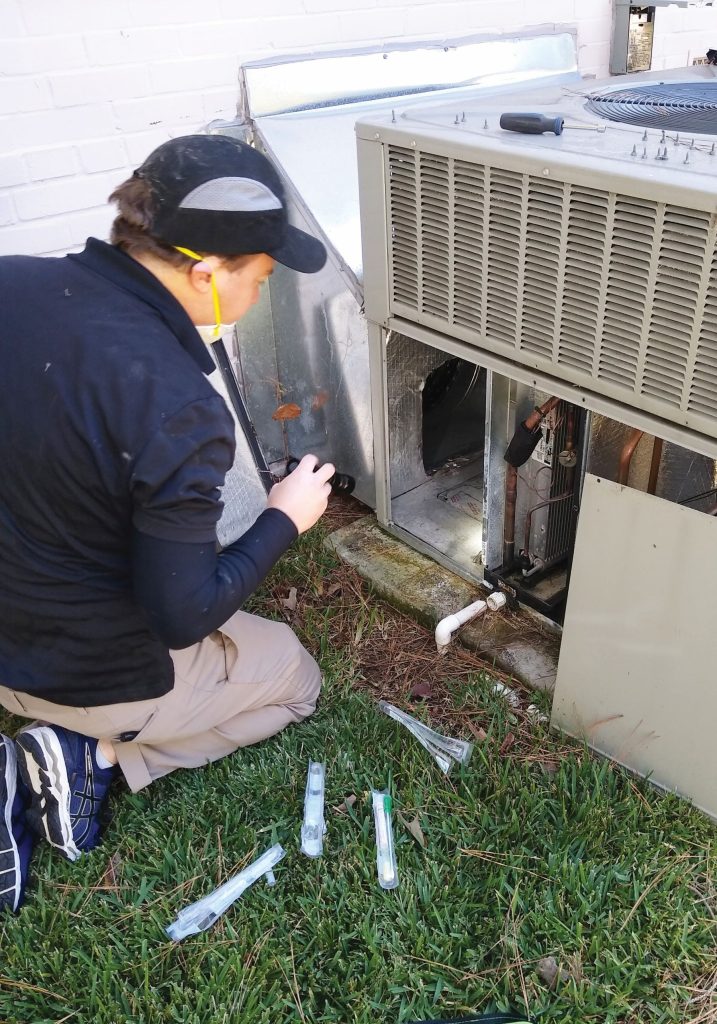
Bill Dolch is not a physician, but he could be described as a diagnostician—not of human illness, but of “sick houses.” Mr. Dolch is the owner of Certified Indoor Air, Inc., of the Triangle, a company that provides comprehensive mold testing and air quality inspections in the Greater Triangle area.
“The Environmental Protection Agency estimates that as many as 50 percent of buildings have water damage significant enough to produce health problems—some very serious—from mold and bacteria growth in water-damaged buildings,” says Mr. Dolch. “However, most people are unaware of the toxins they’re exposed to in their own homes, and the first cues may be an unexplained illness.”
“Most often, people only become aware of a mold problem when it makes them sick,” he says. “And many of our clients come to Certified Indoor Air after a frustrating, sometimes lengthy process of seeking a medical explanation for their symptoms. When a medical explanation can’t be found, their health care provider is likely to advise them to assess their house—and that’s when we step in.
“A very serious condition—CIRS (see box)—is caused by mold; but indoor toxins can also produce less obvious health problems,” explains Mr. Dolch.
“A lot of the most common molds that are found in this area play themselves out in the upper respiratory tract,” says Mr. Dolch. “So, many people complain of sinus congestion, coughing or sneezing, breathing troubles, and asthma attacks; some report brain fog and skin issues.
Symptoms of CIRS
“Chronic Inflammatory Response Syndrome (CIRS),” explains Mr. Dolch, “is a condition with a wide range of symptoms which are triggered exposure to biotoxins—typically mold. The ongoing inflammation can affect virtually any organ system of the body and, if left untreated, becomes debilitating.
“Symptoms of CIRS are among the most useful signals that a home may be contaminated. So, if you or someone you live with experiences eight or more of these symptoms, get them checked out for CIRS.”
- Fatigue
- Pain (increased, unusual), electrical sensation, tingling, numbness, tremors, tics, dizziness, atypical seizures
- Problems with memory, focus, concentration, finding words, confusion, disorientation
- Mood swings, loss of interest in activities, depression, anxiety
- Headaches, light sensitivity, blurred vision, red or teary eyes
- Sinus symptoms, metallic taste in the mouth
- Cough, shortness of breath, asthma
- Abdominal pain, diarrhea
- Frequent urination, excessive thirst, temperature regulation problems, appetite swings
- Weakness, joint aches, morning stiffness, muscle cramps, muscle aches
- Skin sensitivity, sweats, static electricity/shocks
For more information, go to www.survivingmold.com.
“I have to listen closely to my clients,” he adds. “We need to learn about symptoms and health issues they’re experiencing. That information tells us a lot about the potential contaminant we should be testing for.”
Hidden Threats
And it’s reasonable that people don’t automatically assume that they’re dealing with mold, notes Mr. Dolch. “That’s because indoor pollutants are often hidden. But, even if you can’t see it, that doesn’t mean you don’t have it. Mold is likely to be found—and to thrive—behind walls, in basements and crawlspaces, or ventilation ducts. The toxins produced by molds and other microbes are spread through the home ventilation system, posing an invisible but serious health hazard.
“And although mold problems often arise from an event, such as a flood or broken pipe,” he notes, “there are many other ways that mold problems develop—and often they’re surprising.
“A good example is a case a few years ago where we tested a home for the Smith family. Only Mrs. Smith was reacting—but severely. And it turned out she was very, very sensitive to biotoxins. What was unusual was that she experienced problems in the bedroom, but not in other parts of the house. And her problems were extreme; she complained that when she lay down on the bed, she felt like her skin was crawling and she couldn’t breathe.
“Because Mrs. Smith reacted to severely in that one space,” it was reasonable to assume that finding the problem would be fairly easy,” says Mr. Dolch. “But when we tested the bedroom, the ambient air samples in the room came back with very little evidence of contamination—and gave us very little to go on.
“However, the bedroom was a big room and the house was one of these older bungalow-style houses that had knee-wall attic spaces along the outside walls that were being used for storage. So, our next step was to examine the knee-wall spaces.
“And that’s where we found the source of the problem. The insulation along all the walls in these spaces was sandwiched between sheets of clear plastic. It was almost like a terrarium—the plastic on both sides of the insulation trapping moisture. And sure enough, mold was growing wildly in the insulation in every one of these knee-wall attic spaces. And since these spaces were on three sides of the space where the bed was, when Mrs. Smith lay down on the bed, she was reacting to the mold growing all around her.”
That’s one unusual example, says Mr. Dolch, “But it illustrates the nature of the problem. Our houses are full of spaces that can trap moisture, they’re built out of materials that can be described as ‘mold food,’ and their HVAC systems are designed to distribute pollutants throughout the home. Normally, that’s not a problem. But when something—such as a water damage event or a construction issue—alters the healthy balance in our homes, the result can be a ‘sick’ house.”
Detective Work
Finding the source of contamination is meticulous detective work. And it can be especially challenging when it’s not clear when there is a triggering event. “Some molds grow very slowly,” Mr. Dolch explains, “so it may not be evident for some time that water damage has produced toxins. Toxic black molds, for example, are slow growers, and sometimes it’s months after the hurricane or flood before we can measure the toxic impact.”
And then there are what Mr. Dolch describes as “slow events.” For example, he explains, “a plumbing supply line might have an elbow that’s crimped and it’s dripping inside the wall—out of sight, and maybe only when you take your shower. But over time, moisture accumulates producing mold growth—and it’s all happening inside the wall, out of your awareness.
“Our job is to find out where the problem is and its source, and to guide the process of remediation.”
Comprehensive Assessments
Home assessments, says Mr. Dolch, are extremely detailed and thorough. “Our inspections involve careful examination of both the exterior and interior of a home as well as searching for signs of water infiltration, past and present water damage, and mold growth, as well as potential for future water damage.
“Although 90 percent of our work is mold related,” he says, “we also test for organic compounds in the air. These can come from cleaning supplies or off-gassing from different kinds of building materials or furniture.”
The outcome of the assessment is a detailed phone call reviewing all findings and recommendations—from normal building maintenance to remediation. “We don’t do the remediation,” he explains, “but we provide all the information needed to ensure that problems can be remedied.”
When to Test
“Although routine testing for household toxins isn’t necessary,” says Mr. Dolch, “there are a several instances when it makes sense to get an inspection. First and foremost: listen to your body. If you notice a difference in how you feel when you’re in the house compared to when you’re not, that’s a critical cue.” Other cues invite further investigation. “Pay attention to any water event that occurs, even if you think it’s minor. It’s important that building materials dry out within 24 hours,” he explains. “If they don’t, there’s potential for serious problems. And certain types of water damage, as from sewage, are also dangerous.”