Chapel Hill Compounding
For more information, contact:
CHAPEL HILL COMPOUNDING
Zoe Stefanadis, RPh/Owner
105 Conner Drive
Wilshire I building, Suite 1200
Chapel Hill, NC 27514
Telephone: (919) 967-8805
Fax: (919) 967-8205
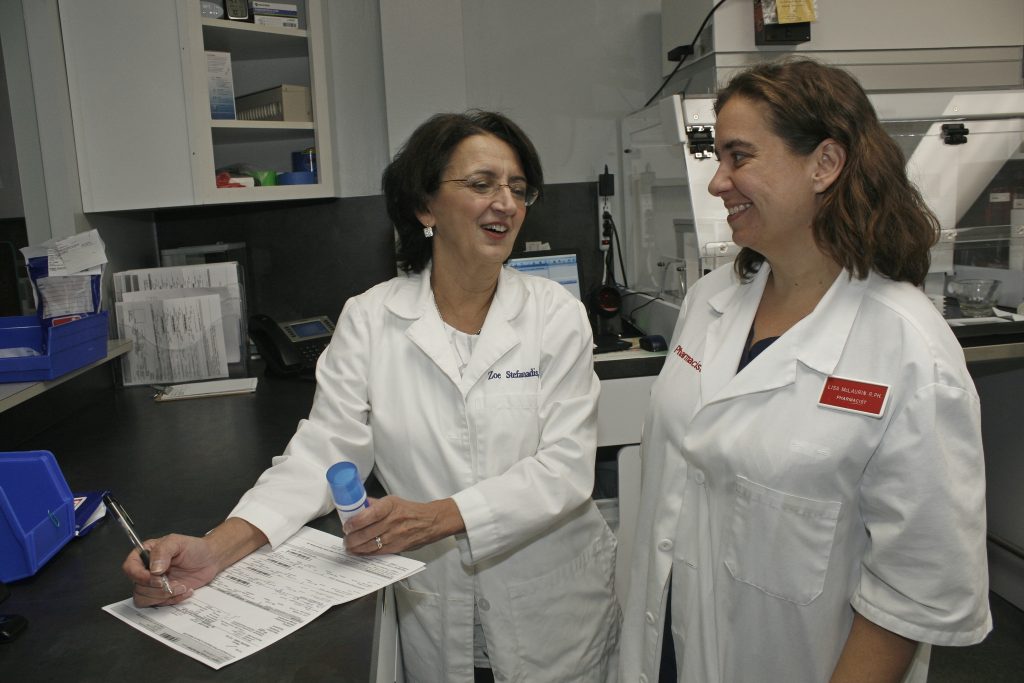
“Pharmacists have a special vantage point when it comes to observing and understanding the health issues associated with aging,” notes Pharmacist Zoe Stefanadis, owner of Chapel Hill Compounding. “We see not only the specific ailments that elderly people deal with, but the unique health challenges they so often face.
“Age doesn’t automatically result in arthritis or heart disease, of course,” she says. “But when our bodies have been around for a long time, there’s inevitable wear and tear, and problems result. You could say that we ‘start outliving our parts.’ And we often enter our senior years with a variety of health issues—many of them chronic. So, the real issue—which I see every day—is the combination of ailments and medications that contribute to difficult health problems for the elderly.”
Compounding in the Changing Landscape of Medicine
Pharmacist Zoe Stefanadis received her pharmacy degree from UNC-Chapel Hill after first earning a degree in public health, at the University of Tennessee-Knoxville. “Actually, my public health work was a perfect introduction to compounding pharmacy,” she says, “because I learned a lot about the potential benefits and problems of medications.”
It is from that public health perspective that Ms. Stefanadis reflects on what she describes as the changing landscape of health care. “Much has changed since I began my career as a pharmacist,” she says. “And much of the changes that I see are related to the role of prescription medications.
“First of all,” she notes, “pharmaceutical solutions to health problems are the standard—much more so than 50 years ago. The doctor’s tool is prescription pad; and everyone wants a pill for every problem. Consequently, drugs are more plentiful, more varied, and more complex.
“The variety and complexity of prescription medications is due, in part, to the world we now live in. We’re more crowded, we travel more, exposures are greater to a greater variety of contaminants, viruses, and allergens. We understand better the role that genes play in triggering different reactions in different people, and the development of new targeted drugs have gotten people to talk about ‘personalized’ medicine—a pill based on a single person’s genetics, condition, and lifestyle.”
This new reality has both benefits and serious challenges, explains Ms. Stefanadis. “For example, new medications, such as biologics, are better able to target the source of diseases, increasing their effectiveness and reducing side effects. And the prospect of being able to design medications that work well for individual patients, while minimizing side effects, is exciting.
“But the dominant role that prescription drugs play in the health care system creates problems,” she adds. “For one thing, commercial medicines are standardized, developed to ensure a high percentage of effectiveness, but also with a willingness to accommodate side effects in order to get there. In other words, they’re ‘one-size-fits-all’ by design.
“The problem of coping with side effects from a one-size-fits-all approach is exacerbated by the related problem of polypharmacy, where people take dozens of medications, for multiple ailments—often to address the side effects from other medications.”
COMPOUNDING:
THE FUTURE OF PHARMACEUTICAL MEDICINE
“Compounding pharmacists,” observes Ms. Stefanadis, “are at the nexus of these predominant and competing trends in health care. We have long been leaders in addressing the problems of one-size-fits-all medicine. (Because one size just doesn’t fit all.) Our goal is not a medication that works for 90 percent of patients; we want medications to be effective for 100 percent of patients, and without side effects. So we tinker with dosages, ingredients, methods of delivery—all for a single patient. Consequently, compounding pharmacists are at the forefront of the movement toward ‘personalized’ medicine.”
Treating a single problem can be straightforward, notes Ms. Stefanadis, “but when someone is dealing with multiple issues—such as arthritis or other chronic pain condition, plus high blood pressure or a heart condition—additional problems often arise. Chief among these is what’s known as ‘polypharmacy’—when a person is taking many different medications at the same time, for many chronic diseases. The result can be additional side effects, dangerous drug interactions, or simply that one medication reduces the effectiveness of another. This is especially true with the elderly,” she explains, “because, as we age, we don’t metabolize the same way, meaning we don’t clear medications in the same fashion as when we’re younger—so you can get into an overdose situation very quickly.”
And it’s a trap a person can fall into gradually, she points out. “They may have a chronic condition requiring medication, then an acute situation occurs and new meds are added on. Unfortunately, since people often have multiple doctors, as time goes on things just keep being added on rather than removed. It’s not uncommon for us to see patients who are taking 10, 20, or more prescription medications! And when you consider that problem interactions can also occur with over-the-counter medications and supplements, it’s easy to understand the seriousness of this problem.”
Compounding Solutions
to Complex Problems
Polypharmacy is just one of the health challenges that compounding pharmacists are uniquely positioned to meet, notes Ms. Stefanadis. “I think our role is to help the people who would otherwise fall through the cracks of the traditional health care system. We’re problem solvers.
“Take, for example, a patient who’s been battling a condition for years—without relief—even though their doctors have either increased doses or added more and more medications. It may be that the commercially available drug doesn’t come in the right dosage; it may be that they need a lower dose. Or it may be that the patient’s genetic disposition affects how they metabolize medications. Compounding pharmacists can often solve such problems—by providing effective alternatives. The complex compounding we do is specifically tailored to an individual patient’s needs, and we are able to prepare medications that are simply not available commercially.”
There are many ways in which compounding can address medication problems, explains Ms. Stefanadis. “Dosages are an important one. We are able to prepare very precise dosages unavailable commercially. This is particularly useful when a patient is gradually adding or coming off a medication.
“The composition of medications is also potentially problematic,” she says. “In addition to active ingredients, they contain fillers, dyes, coatings, and preservatives—which some patients cannot tolerate. Alpha-gal—an allergy to meat-based products—offers a good example, because those with this allergy react to magnesium stearate, common in many medications, and to gelatin capsules. We regularly compound magnesium stearate-free medicines or use vegetable capsules to solve that problem.
“The mechanism for ‘delivering’ a medicine can also be a problem—particularly for patients (many of them elderly), who are dealing with chronic pain along with other health issues,” says Ms. Stefanadis. “And probably the most common and most effective thing that we do is to prepare transdermal pain medications. Because they’re not taken orally, these meds are not absorbed systemically—which can harm the GI tract—and they can be targeted directly to the source of pain. So for the athlete with a localized injury or the elderly person with diminished kidney function, we can offer an alternative: a transdermal anti-inflammatory.”
Alternatives & Counseling
“That’s the message we want to share,” says Ms. Stefanadis. “We want patients to know that there are alternatives to standardized medicines. Commercially available drugs do work for a majority of patients. But that’s the point: it’s a matter of percentages; they’re designed to work for most people but can’t possibly accommodate all the variables affecting individuals.
“I like to say that compounding pharmacists don’t make the drugs,” she says with a smile, “we just make them better sometimes. My approach is to be an advocate for patients—but always as a part of that critically important partnership of patient, physician, and pharmacist. That way you have a true team that is focused on the patient’s history, their current situation, and any future situations to be addressed. “And that brings me back to the issue of polypharmacy. One of the valuable services we can offer our patients is to consult with them—in concert with their physicians—about their medications. Anyone taking multiple prescription medications and using over-the-counter medications and supplements should be reviewing their medication ‘load’ and exploring ways to prevent adverse reactions. We are happy to help with that.”