Central Pharmacy & Central Compounding Center
For more information about these community pharmacy/ education/wellness centers, contact:
Jennifer Burch, PharmD
Sejjal Patel, PharmD
Jhuvon Francis, PharmD
Erica Kelly, PharmD
Chad Palumbo, PharmD
Luke Slotterback, PharmD
CENTRAL PHARMACY
2609 North Duke Street, Suite 103
Durham, NC 27704
Telephone: (919) 220-5121
Fax: (919) 220-6307
www.centralpharmacync.com
CENTRAL COMPOUNDING CENTER
6224 Fayetteville Road, Suite 104
Durham, NC 27713
Telephone: (919) 484-7600
Call to schedule a consultation with our pharmacists
http://www.centralcompounding.com
Durham Women’s Clinic: Supporting Women Through the Ages and Stages
of Their Lives
“Hormone replacement therapy,” notes Dr. Frank Frenduto, “is just one example of the broad spectrum of care offered by Durham Women’s Clinic. The practice has been on the cutting edge in women’s health care since its creation over 80 years ago. Its founder, Dr. Eleanor Easley, was the first woman in history to receive a four-year medical degree from Duke University, leading the way on many ‘firsts,’ including becoming the first medical practice in North Carolina to have in-house midwifery services.
“And, in the nearly 30 years since I joined the practice, Dr. Easley’s commitment to holistic care for women of all ages has been reflected in a steady expansion of innovative options, including most recently its Pelvic Floor Therapy and Centering Pregnancy Programs. It’s been a joy to be a part of that evolution.”
For more information, contact:
DURHAM WOMEN’S CLINIC
DURHAM
209 East Carver Street
Durham, NC 27704
Telephone: (919) 471-2273
Fax: (919) 479-0884
contactus@whadwc.com
https://www.durhamwomensclinic.com/
BRIER CREEK
7780 Brier Creek Parkway, Suite 330
Raleigh, NC 27617
Telephone: (919) 914-9000
Fax: (919) 479-0884
contactus@whadwc.com
https://www.durhamwomensclinic.com/
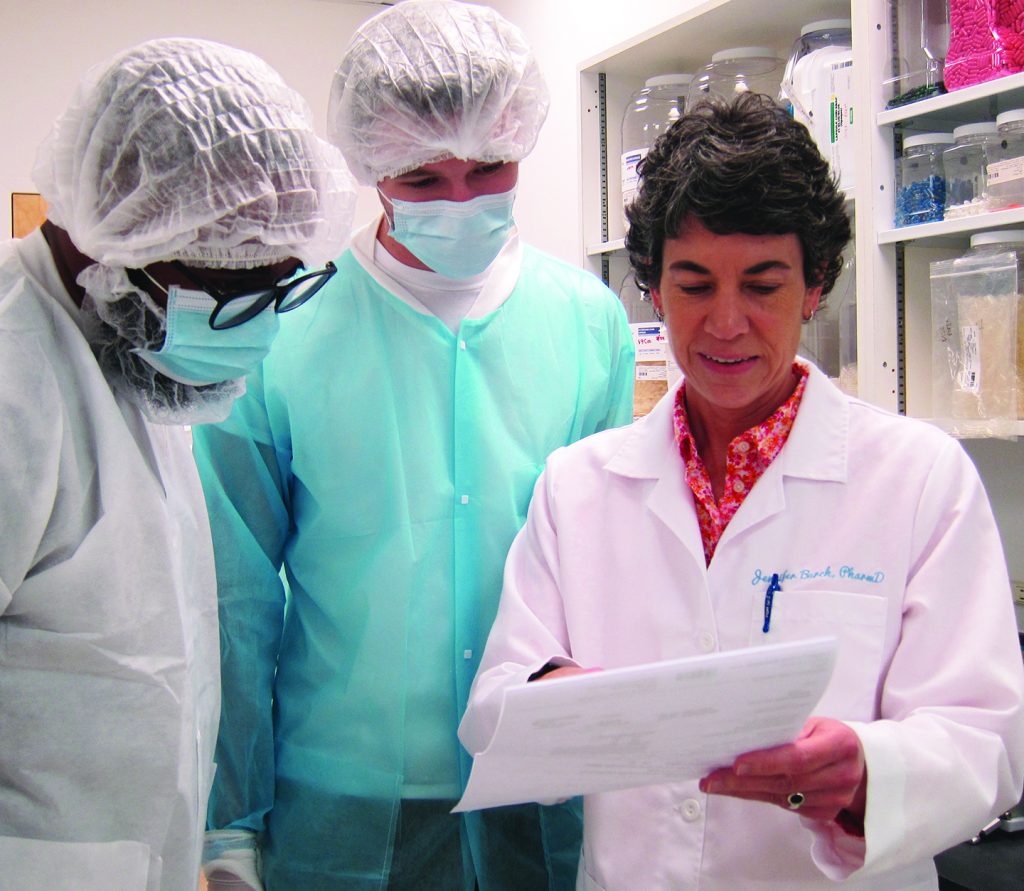
Hormone replacement therapy (HRT) has been used for decades to alleviate symptoms of menopause and other hormone-related conditions. More recently, says Pharmacist Jennifer Burch, of Central Compounding Center in Durham, “there is growing understanding of the role that HRT can play in maintaining health as we age.
“While HRT can play a critical role in addressing hormonal imbalances,” says Dr. Burch, “it’s a complex and, necessarily, highly individualized therapy—precisely what compounding pharmacies are designed to provide. Which is why HRT is a major focus of the work we do at Central Compounding Center.
“Testing is a critically important component of our HRT program,” says Dr. Burch. “Equally important are collaboration and education. In fact, I would argue that HRT is a perfect example of individualized medicine where patient, practitioner, and pharmacist work in partnership. We work collaboratively with physicians and veterinarians on the broad range of medications we compound. And that patient-practitioner-pharmacist triad is an especially important part of all our HRT work.”
One such partnership is the long-term relationship between Central Compounding Pharmacy and Durham Women’s Clinic. In a conversation with Health&Healing, Dr. Burch and Dr. Frank Frenduto of the Durham Women’s Clinic describe how they approach hormone replacement therapy and issues related to it.
Correcting Myths About Hormone Replacement Therapy
“For over 20 years,” says Dr. Burch, “an unfortunate myth has persisted—that hormone replacement therapy (HRT) increases a woman’s risk of heart disease and breast cancer. The myth originated with the 2000 Women’s Health Initiative (WHI) study, which appeared to find a correlation between HRT and these risks. The study had a huge effect: Within months, the number of women using HRT dropped by almost half; and even today there continues to be confusion about the risks and benefits of HRT.
“Unfortunately, the 2000 WHI study and its conclusions were flawed; and, in fact, HRT is both beneficial and safe—something that has been affirmed by multiple research studies over the past two decades. A study published in the Journal of the American Medical Association (JAMA), for example, concluded that, “Among women below the age of 60, we found hormone therapy has low risk of adverse events and [is] safe for treating bothersome hot flashes, night sweats, and other menopausal symptoms.” Additionally, says Dr. Burch, “multiple studies have repeatedly found that hormone therapy goes beyond simply treating menopausal symptoms, offering protection against bone loss, breast cancer, and heart disease.”
HRT: Staying Healthy as We Age
Health&Healing: What’s the role of HRT in healthy aging?
DR. BURCH: When we think of the connection between hormones and aging, we most often think of the hormonal changes women experience during menopause. But hormonal balance is critically important to all aspects of our health. Hormones affect every cell in the body, working together to help regulate all the body’s processes—not only reproduction, but metabolism, blood pressure and blood sugar regulation, sleep cycles, and much more.
So, maintaining hormonal balance is essential in all stages of our lives. But it is of special concern as we get older because hormone levels fluctuate, and many—such as estrogen and testosterone—decrease with age. And because hormones work together to regulate bodily functions, imbalances can have a significant impact on health. For example, if estrogen, progesterone, testosterone, and cortisol aren’t balanced, the thyroid doesn’t function properly.
DR. FRENDUTO: Because hormone balance is so important, HRT has always been an important part of the care provided at Durham Women’s Clinic, especially for our elderly patients. Indeed, when I began practicing there in 1998, all my patients were on hormones, continuing into their 80s. And they certainly benefitted from the therapy—most significantly by relief from vasomotor symptoms and improvement in vaginal health. Those changes provide another important benefit: when relieved of symptoms, they sleep better, and quality sleep is essential for overall health.
While hormonal imbalances aren’t limited to menopausal women, the benefits of hormone replacement therapy are best illustrated by the decades of experience treating menopausal symptoms. In menopause there is a decline in the reproduction hormones. But those hormones also play a critically important part in governing other body functions. For example, estrogen also may play a key role in prevention of cardiovascular disease, colon cancer, and Alzheimer’s disease.
And if you look at hormonal decline in the context of women’s life expectancy, the value of HRT is obvious. Simply put, women are living longer—way past childbearing years. The average age of menopause is around 52, so—without treatment—women could live another 50 years without the hormones that have supported them since puberty.
HRT: Complex and Individual
H&H: You have described the complexity of HRT; explain what you mean.
DR. BURCH: HRT works by replacing hormones that are naturally produced by the body but decline with age. The resulting imbalance—too much or not enough of one or more hormones—can cause a variety of problems. But simply identifying a lack or excess of one or more hormones doesn’t tell the whole story. Hormonal imbalances are extremely complex. I describe them as “hormone symphonies,” reflecting not only levels but interactions between hormones. Teasing out the precise nature of imbalances—and their cause—is essential to effective hormone replacement therapy.
DR. FRENDUTO: Complexity is an issue, because HRT is about balancing multiple hormones as we age—and hormones change as we get older. Education is important, and one of the biggest challenges we’ve faced over the last couple of decades was to deal with the unfortunate misunderstandings that arose from the 2000 Women’s Health Initiative study (see box, right). For many years because of that study HRT was widely believed to be unsafe—something that has been contradicted by multiple studies and clinical experience since then.
Today, HRT is now widely acknowledged to be an important, positive therapy to support our health as we age, some even describe it as an “anti-aging” treatment. The key, of course, is to design the therapy to meet the needs of the individual patient.
Compounding:
When One Size Doesn’t Fit All
H&H: What is the role of compounding in HRT?
DR. FRENDUTO: While commercially available hormones work well for many women, we’ve learned in working with Jennifer just how valuable customized, compounded products can be. This is especially true of the increasing number of patients seeking HRT for perimenopause. Their needs are more challenging because they are no longer on birth control pills and—because of the influence of social media—they are often taking other supplements. Understanding this more complex mix requires more detailed testing and customized, compounded medications.
DR. BURCH: Simply put, to be effective, HRT needs to be individualized. Hormonal imbalances are complex conditions. For example, while you and I might have similar symptoms, the hormones causing them might be entirely different. So, precise testing is the first step to effective therapy. Compounding is the next.
We use only bioidentical—not synthetic—hormones. And with BHRT, precise dosages are extremely important, and compounding allows us to use lower, more precise doses than is possible with commercially available products. So, comprehensive hormone testing and monitoring—for each individual—is essential, because it allows for accurate hormone adjustments. (see below)
The delivery system—how we get the hormones into your system—is also important. And this is where compounding can be especially beneficial. Transdermal delivery is still my favorite way to provide hormones. It allows us to use lower doses, and there are other benefits to bypassing the digestive system. We are also able to combine hormones in a single application.
Patient-Physician-Pharmacist Triad
H&H: You have described a collaborative process; how do you work together?
DR. BURCH: It really is a Triad. The process can be initiated in a number of ways. Thanks, in part, to the growing influence of the Internet, patients often begin the process, seeking information about how to address their specific symptoms and needs. At the Compounding Center, we offer a comprehensive testing-consulting program that patients can request. When the test results come in, we schedule a counseling session to review them and address any questions. Patients can then take the results to their providers. Other times a provider, such as Dr. Frenduto, will contact us directly on behalf of their patients.
What’s unique about writing a prescription for a compounded medication, is that it’s sort of a blank canvas. That’s the beauty of compounding. It allows us to prepare unusually small dosages, to taper dosages up and down, to protect from allergies, to use a cream instead of a pill, and to make many other patient-specific adjustments.
But that blank canvas can sometimes be a little overwhelming. So that’s where that Triad comes into play—where we work closely with practitioners to help “design” each prescription. And it commonly happens that in conversation with the practitioners, we will suggest precise options and alterations to meet a specific patient’s needs.
DR. FRENDUTO: We’ve found that commercially available dosages will work for some patients. But, increasingly, we’re finding that more precise adjustments are necessary for individual patients. And that’s where compounding comes in. The Compounding Center offers a level of testing that is more detailed than the labs we do. Even more important, Jennifer’s deep knowledge and experience in hormone testing is an incredible resource. And for patients wanting guidance and therapy to deal with hormonal imbalances and supplements, her help is invaluable.
Comprehensive Testing,
Individualized Medications
“The data strongly affirm the value of hormone replacement therapy,” says Dr. Burch, “However, to be effective, HRT needs to be individualized.
“Hormonal imbalances are extremely complex conditions,” she explains, “and symptoms can be misleading. The same symptoms could signal low levels of one hormone or high levels of another. So, we don’t make assumptions. Accurate hormone testing and monitoring—for each individual—is essential, because it allows for precise hormone adjustments.”
“The hormone testing protocol at Central Compounding Center is comprehensive,” says Dr. Burch, “including measuring levels of all hormones and monitoring those levels over time. After the initial test, we’ll test again three or four months later to make sure we’re in the ballpark, and may fine-tune the dosages. Then we’ll test annually to see how folks are doing—because hormones may change over time.
“Our tests are comprehensive,” says Dr. Burch, “measuring all hormones—estradiol, estradiol progesterone, testosterone, DHEA—as well as cortisol levels. We also use either a saliva test or a finger-stick (capillary blood) test, because these methods examine the free usable hormone available in the body. Standard serum blood tests are less precise. As a result, those patients typically end up being prescribed much higher dosages of hormones than if salivary hormone testing had been used.”