TMJ & SLEEP THERAPY CENTRE OF RALEIGH-DURHAM
For more information, contact:
Charles Ferzli, DDS, FAACP,
DABCP, DABCDSM, DABDSM
TMJ & Sleep Therapy Centre
of Raleigh-Durham
1150 NW Maynard Road, Suite 140
Cary, NC 27513
Telephone: (919) 323-4242
RaleighTMJandSleep@gmail.com
www.RaleighTMJandSleep.com
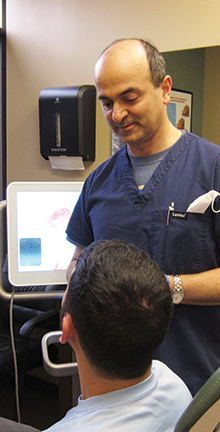
More often than not, pain is what brings patients to Dr. Charles Ferzli’s TMJ & Sleep Therapy Centre in Cary. “It comes in all varieties,” he says, “including jaw pain, headaches, neck pain, back pain. But whatever its location, the pain typically has one common characteristic: it’s something for which the patient has repeatedly sought relief, without success. In each case, our challenge is to find the source of the patient’s discomfort.
“And that can be quite a challenge,” he acknowledges with a smile. “Because there is rarely a single source of pain. Instead—especially for those who have suffered for some time—many, many factors are involved. It’s a slow spiral, that may begin with an injury or an allergy and, over time, other problems or habits accumulate and contribute to what eventually becomes a serious pain issue.”
Health&Healing: What are those contributing factors?
DR. FERZLI: It varies, of course, with each patient. Clenching and grinding of teeth can be a major contributor. And many things provoke clenching and grinding—including medications, stress, mouth breathing, and sleep disruptions.
The list is a long one. Anxiety and depression affect your response to pain, just as pain affects your emotional state. Breathing problems, allergies, and digestive issues can all have a major impact. Perhaps the most powerful are sleep problems and inflammation. What’s important to understand is how these factors connect.
For example, during deep sleep, your body works to repair muscles, organs, and other cells, and strengthen your immune system. But if your sleep is interrupted or your cells are not well oxygenated during sleep, healing can’t take place, and pain will persist.
Furthermore, the pain you’re experiencing—perhaps from an injury—will contribute to sleep disruption, compounding the problem. Inflammation is a major culprit in this vicious cycle. The source of the inflammation may vary. It can come from dietary problems, a virus, or an allergy. Whatever the source, it can interfere with sleep and recovery, and that produces more inflammation in the body, and with more inflammation, you can feel pain more easily.
H&H: How do you identify the sources of a patient’s pain?
DR. FERZLI: It’s a comprehensive process. The first thing we do is to determine if the pain is life threatening, or if there’s an organic cause—such as a tumor or trauma. In that case, we’ll refer them to the right medical professional to treat that source of the problem, so that they can be out of pain. But, since most patients have come to us after exploring those possibilities, we are looking for more complex answers. And we begin with an exam and a questionnaire.
We always ask: What do they think caused the pain to begin with, and what makes the pain better? How long has the pain gone on? When it hurts, how long does it hurt and what is the pain like? Is it throbbing? Dull? Burning? The more information we have, the better able we are to help our patients.
The examination process is multi-layered. Let’s say they don’t know where the pain is; they’re just hurting. Since a lot of pain comes from the mouth, we’ll evaluate the teeth carefully. To determine if the pain is coming from the muscles rather than the teeth, we’ll numb certain areas.
If it’s muscular, we can evaluate it differently. We’ll palpate the muscles of the head, to basically develop a map of the different parts of the head and neck, and how they respond to touch. And we’ll measure range of motion because that illustrates the extent to which the jaw opening is protecting the muscles from hurting.
H&H: What other cues are you looking for,
especially if the pain is not localized in the mouth?
DR. FERZLI: I mentioned our questionnaire—which is an extremely important tool. We ask our patients over 100 questions that help identify the factors that contribute to their pain issues. We want to know about headaches and earaches, whether they sleep well, if they have dry mouth or morning hoarseness, the medications they take, if they snore—and about many, many more possible contributors to their health issues. Our job is to connect the dots—to identify how these various symptoms and habits come together to create problems.
H&H: And how do you go about “unwinding” that downward pain spiral?
DR. FERZLI: An important part of the process—maybe the most important part—is education. The evaluations make it possible to understand the problem—not only the source of the pain, but the other factors that exacerbate it and prevent healing. And this information is shared with the patient.
The Western attitude, unfortunately, tends to define “pain relief” as taking a pill. So, we take some Tylenol or Advil, and then we’re good for a while; then it happens again. Eventually the body breaks down enough to where the Tylenol and Advil are not enough to manage the pain. At this point the choice is to reach for something stronger, or to understand the problem and how to fix it.
That’s where we come in. When it comes to assessing pain, having somebody who can examine the patient and connect the dots for them is invaluable. At that point, healing is to a great extent up to the patient. We can identify the sources of their problems, but they have to make the choices. So many of the contributing factors are, in fact, lifestyle choices—eating well, drinking water, exercising, breathing and sleeping habits.
Our job is to try to see everything that applies to that person, to paint a picture of how things are connected, and then come up with a game plan so they can function better. It’s likely that very specific interventions—such as oral appliances to help reposition the jaw—can help. Some testing may be needed, and we might refer them to a chiropractor or physical therapist if that support is important. But education is the most important tool we have to help patients “unwind” that spiral.
If the patient is ready, that’s when healing takes place. And the thing that makes them ready will vary from patient to patient. I’ll give you an example. I saw a patient recently in my dental practice for a hygiene appointment. During the exam she told me that she has extreme dry mouth, and had gone to the doctor for relief, but it hadn’t helped. Then I asked her how she sleeps, and she told me she tosses and turns a lot, and doesn’t wake up rested.
For me, there’s a connection, because if you’re breathing from your mouth, your mouth will be be dry, and there’s no way your sleep quality will be any good. So, then I wanted to talk to her about that connection, and I asked if she snores, if she has acid reflux, high blood pressure, diabetes—and then noted how many times she said “yes.”
From there we did an exam and consultation, and she now has a complete picture of the health issues involved. The important point is that this process began because of her dry mouth problem—that’s what drove her to have that consultation. For someone else the tipping point may be snoring, or pain. Everybody chooses to get treated based on how ready they are to be treated.