TMJ & SLEEP THERAPY CENTRE OF
RALEIGH-DURHAM
For more information, contact:
Charles Ferzli, DDS, FAACP, DABCP, DABCDSM, DABDSM
TMJ & SLEEP THERAPY CENTRE OF RALEIGH-DURHAM
1150 NW Maynard Road, Suite 140
Cary, NC 27513
Telephone: (919) 323-4242
RaleighTMJandSleep@gmail.com
https://RaleighTMJandSleep.com
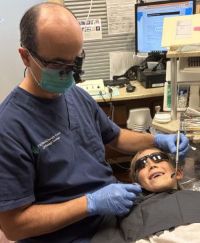
“Early on, it was clear that our son Djaro had issues with his mouth and jaw,” recalls his mother, Jaydee Azavari. “He was born with a tongue tie, and although that was corrected, it also seemed that his upper and lower jaws weren’t aligned correctly. That this was a problem became obvious when his teeth started coming in and he began having sleep issues—trouble staying asleep and a lot of bad dreams. We were certainly concerned.”
In their search for solutions to Djaro’s sleep issues, the Azavaris found their way to Dr. Charles Ferzli of the TMJ and Sleep Therapy Centre in Cary. “That’s a long way from home,” acknowledges Mrs. Azavari, “as we live in Asheville. But our chiropractor referred us to Dr. Ferzli, emphasizing that Djaro’s structural problems would have to be fixed before we could address his sleep issues.”
So, despite the “long commute,” six-year-old Djaro embarked on his healing journey with Dr. Ferzli a year ago.
Healthy Jaw Development:
Foundation for Sleep, Breathing, Growth
“It’s hard to overstate the importance of healthy jaw development in children,” observes Dr. Ferzli. “It plays a critical role in overall health, because when the jaw is well developed and aligned, it allows the tongue to be positioned correctly and for teeth to come in properly. Most importantly, it allows for healthy, unobstructed breathing. Unobstructed breathing, in turn, is essential for quality sleep; and quality sleep is the foundation for health.

“There’s a reason that we spend a third of our lives sleeping,” says Dr. Ferzli. “Because sleep—in all its stages—is the foundation for healing, growth, and cognitive processing. When we don’t sleep, we don’t learn, we have trouble remembering things, and—most important—we don’t heal. This is especially important for children, since the hormones secreted while we sleep not only support healing, but allow children to grow. In fact, most of children’s growth happens during their sleep.
“It’s also true that many—if not most—sleep problems are related to breathing issues,” he adds. “You can’t separate the two. Furthermore, how you breathe is fundamental to protecting and maintaining your health. And the right way to breathe—the way that ensures that you’re getting the oxygen you need—is through your nose.
“Djaro’s case,” says Dr. Ferzli, “is a perfect illustration of the connections between jaw development issues, sleep, and breathing. He was born with tongue tie and severe jaw development issues, including a very, very small mouth and crowded arch. Because those structural issues impaired his breathing, sleep problems were inevitable.”
Oral Appliances: Small Adjustments That Make a Big Difference
Jaw pain has many sources, and healing the problem at its source typically takes time and a combination of therapies. The first step on that path, however, is the use of a powerful tool that not only provides quick relief of painful symptoms but sets the stage for the healing process.
“Without question,” says Dr. Ferzli, “specially designed oral appliances are among my most valuable tools for treating jaw and sleep problems, and are typically the first step in the process.
“At this stage,” he explains, “we are treating symptoms, without changing the physical structure of the jaw—that will come later. But symptom relief is immediate. By using the appliances, we decompress the joint, reduce inflammation, relieve pain, and allow the joint to heal. And we improve sleep quality by preventing the airway from collapsing.
“Oral appliances are designed for each individual patient and are adjusted to meet different needs at different stages of treatment,” explains Dr. Ferzli. “They are used to decompress the jaw joint and guide the jaw into a healthier position, allowing it to function better, relieving pain. For someone with upper airway resistance or sleep apnea, oral appliances optimize the airway by preventing the lower jaw from falling back during sleep. Children’s jaw problems can be fixed using orthopaedic devices that expand the upper arch so that there’s room for the tongue and a healthy airway. So, there are many different things that we accomplish with the design of oral appliances.”
Fixing the Problem
Because of Djaro’s serious structural issues, Dr. Ferzli’s first step was a sleep study to determine if he had sleep apnea. While he did not test clinically for sleep apnea, the study revealed that he did have significant airway obstruction.
“That, by the way, is a common occurrence,” notes Dr. Ferzli. “Since a sleep apnea diagnosis is based on very specific test results, it often happens that other serious breathing problems—such as UARS (Upper Airway Rsistance Syndrome)—may be missed if sleep apnea is not diagnosed.”
Since Djaro’s airway issues were caused by structural problems—his small mouth and crowded arches—the first step in his treatment plan was to move his maxilla forward and expand his arches orthopaedically.
“The good news when treating such structural issues is that children’s skulls are malleable,” explains Dr. Ferzli. “By moving the maxillary bone apart, we can expand the arches and make more room for the tongue. This also expands the nasal cavity, opening the nasal airway.
“This is done with specially designed orthopaedic appliances, that are adjusted incrementally to gradually widen the jaw. A year after beginning this process with Djaro, the orthopaedic expansion is complete,” says Dr. Ferzli. “A follow-up sleep study is important to determine if he still has airway problems requiring additional expansion. If not, the next step is to maintain that expansion to allow his permanent teeth to come in properly. We do that with a retainer, which he wears around the clock.
“We’ll continue to monitor his growth and development, as his permanent teeth come in. Once they come in and they’re all in, then we just do orthodontic treatment to align the teeth nicely without losing the expansion.” For Djaro, his mother reports, the journey has been a positive one. “I can imagine that the adjustments to expand his arches were difficult, but he just got rolling with it; children are so resilient! And Dr. Ferzli has been incredibly supportive in designing a plan that brings all the pieces together—to address the sleep problems and make the long-term adjustments to Djaro’s mouth.”
Connecting Our
Moving Parts
“Our bodies are designed for movement,” observes Dr. Ferzli. “When we stop moving, that’s when we die. ‘Movement,’ however, refers to many things. When it comes to TMJ (temporomandibular joint) issues, there are two kinds of movement that are of particular concern: movement in the patient’s body and movement of the patient’s body.
“One of the first things I look for,” he explains, “is the patient’s blood flow and the levels of nitric oxide in their bloodstream. Nitric oxide is the gas that allows blood hemoglobin to carry oxygen to the tissues. Without nitric oxide, oxygen does not get delivered to the tissues; and without sufficient oxygen, tissues become unhealthy, we begin having pain and inflammation.”
Inflammation, he says, “is the source of the symptoms that bring people to us. If your brain perceives that there’s not enough oxygen going through your jaw muscles, you start to clench your teeth to get oxygenated blood to the tissues. If you clench your teeth a lot, eventually the muscles get tired, the joints get tired, they get inflamed, and you start having jaw pain and discomfort and headaches. That’s why oxygenation of tissues is so important, and why we look at nitric oxide levels.”
Gait, Balance, Posture
“Patients’ physical movements—their gait, balance, and posture—are also important,” says Dr. Ferzli, “For example, a valuable tool in evaluating a new patient is to assess their gait and balance. When a patient’s posture is not very stable, something is driving that pattern. Pain in one part of the body, for example, will cause postural adjustments—counterbalancing the body from the head and neck all the way to the toes. Checking balance and gait helps determine what’s causing the postural compensations.
“Many possible sources trigger those adjustments—from injuries to lifestyle habits, even breathing patterns. For example, if I cannot breathe well from my nose, I’ll adopt a forward posture because it opens up my oral airway. With that forward posture, I’m putting more stress on my neck muscles; that can result in lower back pain. And so I may stand differently, rotating my hip forward to compensate. It’s all connected.”
The patient’s activity level is also important, adds Dr. Ferzli. “We want to know what they do on a daily basis. Do they sit at their desk all day long? Do they have a forward posture from looking at the computer screen or their phones? These things also have a powerful impact on not only jaw health, but overall health.”