RAISING HEALTHY CHILDREN
Educators from Carolina Friends School in Durham explore the relationship between health and education.
Contact the school at:
CAROLINA FRIENDS SCHOOL
4809 Friends School Road
Durham, NC 27705
Telephone: (919) 383-6602
www.cfsnc.org
Katherine Scott is Communications Coordinator at Carolina Friends School. A native North Carolinian, she holds a BA in graphic design and art history from Meredith College and an MA in art history from Rutgers University. She came to CFS in 2016 with six years experience in marketing and communications, most recently at the Kenan Institute for Ethics at Duke University. In addition to graphic design and digital photography, Katherine is a consummate storyteller, always exploring new narrative forms, visually and otherwise. Her diverse experiences have provided her with expertise in strategic communications and project management. Katherine is also a current parent of a Carolina Friends School student.
Although intended as a method of evaluating students’ progress, grades—whether on tests or report cards—are too often more of a judgment than a useful assessment. As a consequence, grades are among the more stressful aspects of the school experience. Carolina Friends School’s Communications Coordinator, Katherine Scott, explains how the Carolina Friends School’s “grade-free” system of assessment is more empowering and less stressful.
By Katherine Scott, MA
Just as in a medical diagnosis, when it comes to gauging a child’s knowledge building and retention, the why can be just as critical as the what. Educators must pull from a rich toolkit to discover where a child is on their journey to knowledge, understanding, and demonstration of new information and concepts.
At Carolina Friends School, our authentic, thoughtfully designed approach to student assessment is one of our greatest strengths. Educational research has established the benefits to students of evaluation that goes beyond cumulative letter and number grades. In the last four years, a growing movement of schools across the globe are choosing alternative assessment methods. But Carolina Friends School’s pioneering educators recognized the value of a more holistic approach from the very beginning.
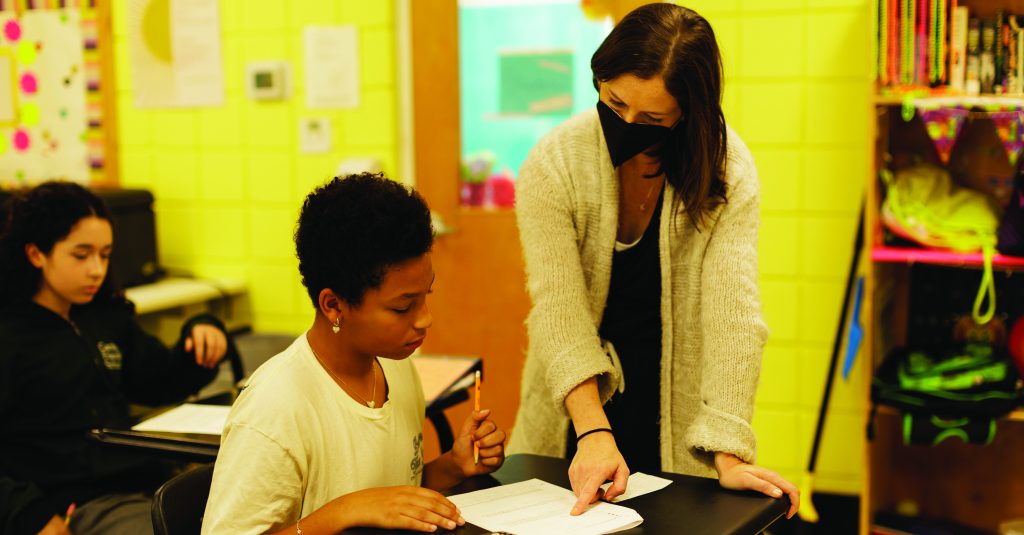
Student narratives—the cornerstone of our assessment—provide teacher observations as well as results of multiple data points. These include a variety of testing techniques and demonstrations of knowledge: from quizzes to podcasts, in-class games to group projects, and written assignments, just to name a few. We continually examine our portfolio of tools based on current research in child development and recognized best practices in qualitative and quantitative measures. While teachers collect this information to share with families, the role of the student in the process is crucial. Our assessment process teaches students how to recognize good work, identify weak points, and to set a high bar of excellence for themselves.
From Reward and Punishment to
Feedback and Encouragement
By shifting the focus away from the reward or punishment that comes with traditional grading and toward feedback and encouragement to dig deeper and reach higher, students are able to focus on the depth of their knowledge and understanding. It also encourages hands-on and interactive learning—while the path to a student’s mastery of concepts and skills is important, the differences from one student’s path to another are not. Without the stigma of traditional report card grades, students are freed to take chances, to explore a topic or skill that challenges them without fear of failure. Because the assessment is continual, it also allows students to continue working in an area until they are able to understand and apply that learning, progressively building from a place of strength. Assessing student progress in this holistic way also helps to reduce the role of bias in grading. Each individual learning style is informed, in part, by their experiences. Personal identities of gender, race, religion, culture, and socio-economic status are just a few of the facets that shape not only a child’s lived experience but also a teacher’s. Providing a variety of ways to evaluate students’ learning creates more opportunity for them to demonstrate that growth, and it removes the additional identifier of being an “A” or “C” student. Each child is encouraged in a way that allows them to be their best.