Cynthia Gregg
Face & Body Specialists
For more information about the practice, contact:
CYNTHIA GREGG, MD, FACS
FACE & BODY SPECIALISTS
Cynthia Gregg, MD, FACS
3550 NW Cary Parkway
Suite 100
Cary, NC 27513
Telephone: (919) 297-0097
https://cynthiagreggmd.com
“All skin needs anti-aging care.” asserts Dr. Cynthia Gregg of Cynthia Gregg Face and Body Specialists, “because healthy skin plays such an important role in maintaining our overall health. And our skin changes, inevitably, as we age. It becomes thinner, more fragile, more susceptible to injury, and gradually loses its protective qualities.
“It’s not just time that ages our skin,” she adds. “Personal choices about sun exposure, smoking, diet, and other lifestyle factors can accelerate the aging process, as do external factors such as pollution and stress.”
Further, she says, “the modern world poses another—serious and increasing—threat to our skin health: hidden toxins. These are the chemicals present in many personal care products—which we take into our bodies on a routine basis without realizing it.”
Some of these chemicals—especially fragrances—are merely irritants, causing mild allergic reactions, notes Dr. Gregg. “But of greater concern are the ingredients known as endocrine-disrupting chemicals (EDCs). These may mimic or interfere with the body’s hormones and are linked to a variety of serious developmental, reproductive, brain, immune, and other problems. Further, these chemicals are more easily absorbed through the skin, so it is especially concerning that so many skin care products contain them.”
October Special
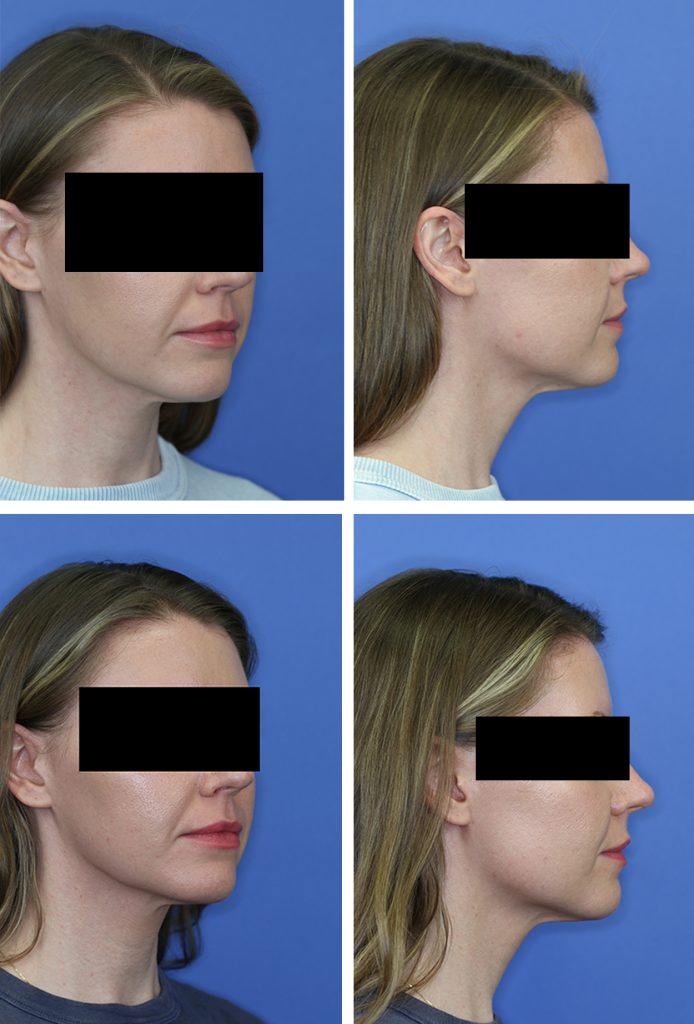
Are you dealing with loose, jiggly skin? Tighten your lax, saggy skin with the highly effective, non-invasive Sofwave™ treatment!
When you purchase any Sofwave™ treatment, you will receive a complimentary Alastin® post-procedure product* to amplify your skin’s natural regenerative abilities to enhance visible results!
Sofwave™: Remarkable Technology
for Restoring Skin
“Few things contribute more significantly to skin aging than loss of collagen—a process that naturally begins around age 30,” observes Dr. Gregg. “So, restoring collagen is a critically important anti-aging tool.
“While many of the non-surgical options we offer patients—such as microneedling, fillers, and laser treatments—are effective in increasing collagen production, perhaps the most impressive are the technological advances using ultrasound therapy. The newest generation of these—Sofwave™—is an exciting offering in what I like to call our ‘buffet’ of options.”
Sofwave, explains Dr. Gregg, is a non-invasive method for building collagen, treating facial fine lines and wrinkles, and lifting brow, jaw, and neck. “What’s exciting about Sofwave™,” she explains, “is that it is the first non-surgical method of lifting tissue. It uses ultrasound technology to pass safely through the skin’s surface and heat the mid-dermal tissue at the precise depth and temperature required to rejuvenate collagen fibers.
“The result is firmer, smoother, and tighter skin, on your face, neck, arms, thighs, abdomen, and love handles—anywhere where loose, jiggly skin is a problem. There are no injections, no surgery, and no restrictions; after Sofwave™, patients may immediately return to normal activities.
“Sofwave™,” adds Dr. Gregg, “is also an effective prejuvenation treatment for younger patients who want to add to their collagen ‘bank,’ as well as for patients who want to put off or avoid surgical procedures.”
Parabens, phthalates, and chemical-based UV Filters are among the EDCs commonly found in personal care products.
The good news, says Dr. Gregg, “is that your skin can actually stay healthy with age—especially when you understand how your skin ages and how it regenerates. Happily, for every decade and every issue, there’s something we can do to fight the aging process.”
In a conversation with Health&Healing, Dr. Gregg and aesthetician Kimberly Laird discuss their team’s approach to anti-aging skin care.
Health&Healing: What major toxins contribute to the aging process?
DR. GREGG: We begin aging around 30, when we being losing collagen, as well as elastin and hyaluronic acid. In our forties, we start losing facial muscle mass and volume; hormonal changes as we age will further accelerate the aging process.
That said, for most of us, 90 percent of all aging is from the sun, which breaks down the elastin and the collagen in the skin and causes wrinkles, creases, and lines.
MS. LAIRD: For that reason, the primary anti-aging tool is to make sunscreen part of your daily routine. The trick is to find one that feels wonderful on your skin.
But there’s an important caution: as with all skin care products, you want to be sure there are no problem ingredients—especially EDCs, which are found in some sunscreens.
H&H: How do you evaluate skin care products?
DR. GREGG: Science has come a long way in developing products that mitigate and even reverse the aging process. That is why we use medical-grade skin care products for all our clients. But not all products are equal.
MS. LAIRD: And that’s the challenge! Problem chemicals, including EDCs, are to be found in many, if not most, over-the-counter skin care products.
That’s especially important for acne patients and for women who are of reproductive age, because some of those chemicals affect hormone balance. For those patients or for patients with cancer or other illnesses, we guide them to avoid products that could be detrimental.
It’s also important to understand why we use medical-grade products. While many over-the-counter products include proven anti-aging ingredients—such as Vitamin C—they are not necessarily designed to deliver those ingredients. Medical-grade products will be absorbed as needed; non-medical grade products may simply sit on top of the skin.
H&H: What skin care services do you offer to help repair skin that’s been damaged by sun, chemicals, and pollution?
DR. GREGG: Thanks to remarkable advancements in anti-aging technologies, we can offer what I like to call a rich “buffet” of non-surgical options for treating aging and damaged skin. This includes not only advanced skin care products but laser, light, and ultrasound therapies.
But perhaps the most significant advancement has been the development of what’s known as regenerative skin care. This approach focuses on stimulating the body’s natural cellular repair and renewal processes. A perfect example is the use of microneedling to stimulate the body to produce its own collagen. The outcome of these techniques is a look that is also natural—and that is always the goal of the work we do.
MS. LAIRD: Regenerative skin care represents the science of what we do. The “art” of what we do is to match the technology with the patient’s needs, skin type, health issues, and goals.
While this is a very individualized process, all treatments for damaged skin starts with basic, quality skin care—ensuring that they are using the right cleanser, moisturizer, and exfoliator. We’ll also talk to them about antioxidant protection and, of course, sunscreen. The “right” products vary, of course, depending on each person’s skin type and condition. But those are the basics and the foundation for anything and everything that we do in the treatment room.
The next step is to assess their skin damage and—most important—to understand their biggest concern. For those dealing with years of sun damage, the most pressing concern typically is pigmentation issues; other issues include leathery skin and skin laxity. And they’ll want to know about downtime, treatment schedule, and costs. All these factors help to shape the rejuvenation process. And it is a process—beginning with the area of greatest concern.
A patient I’ll call Mary is a good example of that process. She was in her mid-fifties, with significant sun damage. Her most pressing concern was pigmentation issues, so we began there with a series of IPL (intense pulsed light therapy) treatments in combination with chemical peels. Since Mary had thick skin and dark pigmentation, these and other treatments we chose were specifically tailored to address her concerns.
As Mary’s pigmentation issues were addressed, she then was then ready to address concerns about skin laxity. Over time her rejuvenation program would include treatments and products to maintain the progress she had made. For each patient, rejuvenation is a personal, individual journey. The “buffet” of options we offer make it possible to meet each patient where they are and where they want to go.