Southern Dermatology & Skin Cancer Center
For more information about skin conditions and their treatment, contact:
SOUTHERN DERMATOLOGY and SKIN CANCER CENTER
An Affiliate of Anne Arundel Dermatology
Gregory J. Wilmoth, MD
Eric D. Challgren, MD
Margaret B. Boyse, MD
Laura D. Briley, MD
Tracey Cloninger, PA-C
Stephanie S. Pascale, MSN, FNP-C
Madelyn Pence PA-C
Cheryl Jones PA-C
Shelby Hayslip PA-C
4201 Lake Boone Trail, Suite 200
Raleigh, NC 27607
Telephone: (919) 782-2152
THE SKIN RENEWAL CENTER AT SOUTHERN DERMATOLOGY
4201 Lake Boone Trail, Suite 207
Raleigh, NC 27607
Telephone: (919) 863-0073
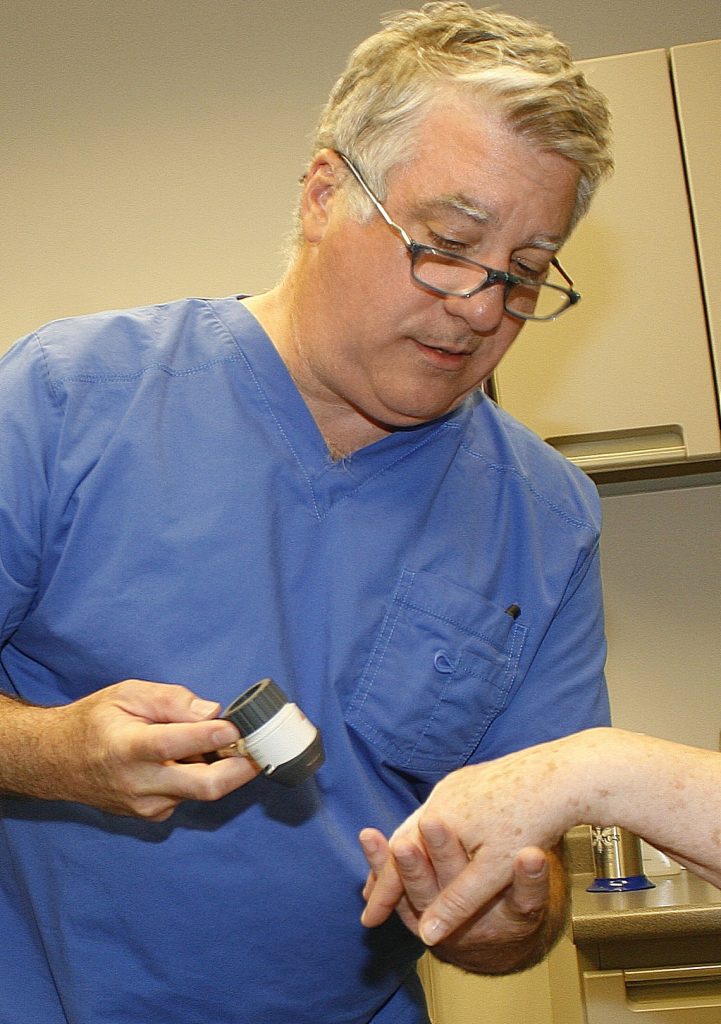
“Few diagnostic tasks are as challenging—or as important—as identifying skin cancers,” observes Dr. Gregory Wilmoth of Southern Dermatology and Skin Cancer Center. “Because, when caught early, skin cancers—even melanoma—are highly treatable, with survival rates higher than 95 percent; but when left untreated they are serious, even life-threatening health problems. So, early diagnosis is of the highest priority.”
Health&Healing: Describe the diagnostic process.
DR. WILMOTH: I would have to say that, in dermatology, the diagnostic process leans heavily toward art. And by that I mean the “art” of seeing clearly and accurately interpreting what we see. Obviously, you need the science behind you, and testing provides invaluable information. But symptoms and data can be misleading.
Dermatologists are trained, day after day, case after case, to see clearly what others may miss, and one of our most valuable tools is the process of differential diagnosis. When we look at a skin cancer or something as common as atopic dermatitis, you can almost hear the clicking noise in our heads, as we tick off the possibilities. It could be this . . . or it could be this . . . or this. A half-dozen or more possibilities present themselves very quickly to the trained dermatologist and, to a very large extent, they come rapidly following visual inspection of the skin problem. And then, based on many factors, we rank-order the possibilities and continue the diagnostic process.
This process is especially important if we are to detect skin cancers in their earliest stages.
Cancer: Early Detection is Key
H&H: Why is early detection important?
The “ABCDEs” of
Cancer Detection
“Accurately detecting skin cancers—especially in early stages—can be a challenge,” acknowledges Dr. Wilmoth. “Because some of the early signs can be pretty innocuous. That is why regular skin checks by a dermatologist are important. We’re trained, day after day, case after case, in the art and science of seeing clearly what others may miss. And we’re much more likely to discern problems in very early stages.
“There are some major cues to be aware of. For example, if anything’s bleeding, that is a sign that that thing needs to be looked at. Any kind of lesion that is a dark brown or black color and it should be evaluated. It may be harmless, but those should always be evaluated. If you’ve got a mole that isn’t brown, but black, that’s a big sign.
“Pay attention to your own life history and physiology. If you’ve spent years in the sun without protection, you’re likely at higher risk. If you’re someone with more than 30 or 40 moles on you, you’re at increased risk for melanoma, and should be seen once a year. Not that moles are precancerous, but they are a marker for risk.
“However, while we certainly advise regular skin checks, monitoring one’s own skin health is easy and helps ensure that cancers will be detected early, when they are most treatable. We also encourage our patients to monitor changes in moles themselves using ABCDE guidelines. Moles are a common type of skin growth. Most are harmless and rarely do they become cancerous. However certain changes in asymmetry, border, color, diameter, and evolution (the ABCDEs)may be signs of cancer. Here’s what to look for:
- A: Asymmetry. One half of the spot is unlike the other half.
- B: Borders. The spot has an irregular, scalloped, or poorly defined border.
- C: Color. The spot has varying colors from one area to the next, such as shades of tan, brown or black, or areas of white, red, or blue.
- D: Diameter. Although they can be smaller, melanomas are usually greater than 6 millimeters, or about the size of a pencil eraser.
- E: Evolution. The spot looks different from the rest or is changing in size, shape, or color.
“When you see something that concerns you, contact your dermatologist to have it examined.”
DR. WILMOTH: It’s really hard to overstate the importance of early detection of skin cancers. Found early, basal and squamous cell cancers are virtually 100 percent curable, and, in many cases, can be completely removed with the initial biopsy procedure alone. But don’t assume they aren’t dangerous. Left untreated, they can be life threatening, and, at the very least, delayed treatment significantly increases risks and costs.
And, although melanoma causes the majority of deaths from skin cancer, it also is highly treatable when caught early—when it is localized and has not spread. Also, thanks to significant advances in treatments the prognosis for melanoma—even in advanced stages—is much improved; but early detection is still extremely important.
The challenge is a diagnostic one. In early stages, cancers are small, and signs and symptoms are often not obvious. They can be as simple as a change in the color or symmetry of a mole; and they can be misleading. Basal cell carcinomas, for example, often masquerade as actinic keratosis, a benign condition, or even as pimples. And squamous cell carcinomas are sometimes misdiagnosed, because they’re inflammatory and may drain. In the case of cancer, such misdiagnoses can be very serious.
Two patients I saw this week illustrate this. One was a 42-year-old who has quite a large squamous cell cancer on her nose. I think she had been a bit in denial, because she had avoided checking it out for over a year. If, a year ago, she had acknowledged that the growth on her nose was unusual (and wasn’t temporary), and had come in to have it evaluated, she would have had a much smaller, less difficult surgery than she faces now.
In contrast, a younger patient had noticed a three- or four-millimeter, tiny brown spot that she had never seen before on her shin. And, because it was unusual, she came in right away to have it evaluated. The biopsy revealed a squamous cell carcinoma that was easily treated. Many people might have just looked at it and done nothing right away. Fortunately, this patient did not ignore it. And the critical cue was not the size or color, but that something was different.
Despite Increased Cancer Rates, an Optimistic Trend
H&H: What incidence of skin cancers are you seeing?
DR. WILMOTH: It’s high; and among older patients—60 years and older—I’m seeing more and more of the sun-related cancers, such as basal cell and squamous cell carcinomas. And, unfortunately, we’re also seeing increased rates of melanoma in that demographic.
It’s not surprising. Skin cancer rates for this generation—the Baby Boom generation—have been on the rise and people now in their 60s and 70s are over five times more likely to be diagnosed with malignant melanoma than their parents would have been. Boomers were notorious sun worshippers, often in pursuit of a “healthy” tan. And although cumulative sun exposure isn’t the sole cause of the high incidence of skin cancers in this age group (it’s also likely due to age and a decrease in immune function), sun exposure is certainly an important factor.
In fact, there is interesting—and positive—new data that underscores the relationship of sun exposure to cancer incidence. A recent report from the Centers for Disease Control indicates that public health efforts warning about the dangers of sun exposure may be paying off. While all forms of skin cancer have been on the rise in recent decades, a recent study shows that melanoma diagnoses have dropped among Americans aged 15 to 44 over the last ten years, even as they increased significantly among older persons during the same time period. It certainly suggests that Boomers’ children and grandchildren have benefited from understanding the risks of sun damage and reflect a generation that has used sunscreens.
“If It’s on Your Mind, It Should Be in My Clinic”
H&H: How would you advise patients—especially older patients—about what to be concerned about and what to look for?
DR. WILMOTH: We have certainly seen an increase in the number of patients with skin cancers, but I credit the rise in the numbers in part to an increased awareness of the risks of skin cancers. We are seeing more incidences; we are also seeing them earlier. So, I would argue that early diagnosis skin cancer begins with the patient.
Dr. Google deserves some credit for increased awareness, but can also be misleading—either unnecessarily frightening or inaccurately reassuring. There are useful guides to identify potential cancers (see box), and—perhaps in the future—AI advances will add to our ability to detect cancers in earliest stages. But I have consistently found that the patient’s own observations are more useful and more accurate than on-line images or descriptions. So, for now, the real key is awareness of the risks and of changes in your own body.
Symptoms are our bodies’ alerts that something is amiss, but a symptom alone doesn’t provide an accurate diagnosis. You aren’t likely to accurately diagnose a problem, but you are the best one to identify a potential problem. When you do, bring it to our attention for an accurate diagnosis.
So, pay attention to changes and if something doesn’t look or feel right, get it checked out. Moles shouldn’t bleed; if something’s different, or bleeding, or black get it checked out. But if it simply is different or doesn’t seem right, have it evaluated. What I often say is “if it’s on your mind, it should be in my clinic.”