CENTRAL PHARMACY
& CENTRAL COMPOUNDING
CENTER
For more information about these community pharmacy/ education/wellness centers, contact:
Jennifer Burch, PharmD
Sejjal Patel, PharmD
Jhuvon Francis, PharmD
Erica Kelly, PharmD
Chad Palumbo, PharmD
CENTRAL PHARMACY
2609 North Duke Street, Suite 103
Durham, NC 27704
Telephone: (919) 220-5121
Fax: (919) 220-6307
www.centralpharmacync.com
CENTRAL COMPOUNDING CENTER
6224 Fayetteville Road, Suite 104
Durham, NC 27713
Telephone: (919) 484-7600
Call to schedule a consultation with our pharmacists
www.centralcompounding.com
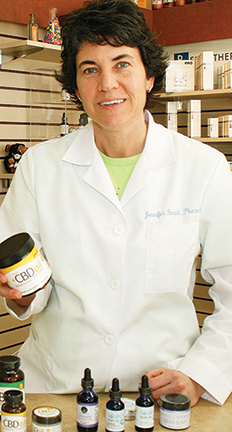
“As a pharmacist—and especially as a compounding pharmacist,” observes Dr. Jennifer Burch of Central Compounding Center in Durham, “the challenge of treating pain in its many forms is central to what we do.
“And there are challenges. Whatever its source, whether it is acute or chronic, pain is a symptom; treating (eliminating) the symptom doesn’t mean you’re solving the problem that produced it. So, the pharmaceutical challenge is to find relief for pain that is effective—but also safe, with minimal side effects, and that doesn’t interfere with healing.
“The first step in that process,” she says, “is understanding that ‘pain’ comes in many forms. It can be acute or chronic; its source can be inflammation, damaged nerves or muscles, even stress. Pain medicines need to address those differences. And that is where compounding comes in.
“Compounding pharmacies are uniquely designed to meet this need,” explains Dr. Burch. “Each medicine we prepare is based on a formula that will most efficiently meet a patient’s needs. The key to this process, of course, is having a close working relationship with the prescribing physicians. And recognizing that there are different kinds of pain is central to that process.
“A recent example illustrates this challenge. A physician texted me recently asking for guidance on treating ‘burning tongue.’ His patient was in severe pain, but the root cause wasn’t clear. He told me: ‘We’re trying to figure out what’s wrong, but in the meantime, we need to get the patient some relief now.’
“That’s not an unusual situation,” notes Dr. Burch. “A medication best suited to address the cause of the pain may not ease the symptoms. And it’s likely that more than one kind of pain is involved. In a case like that, compounding gives you a kind of blank canvas to throw two or three ingredients into the formula so you can hit pain from several different mechanisms.
Cannabidiol (CBD)—Not Just for Pain
While prescription medications are a primary focus of her practice, Dr. Burch also has considerable interest in non-pharmaceutical options for treating medical conditions, and has become a dedicated student of the properties and uses for cannabidiol (CBD).
Since its approval in 2014 for over-the-counter sale in North Carolina, CBD has been widely used as an alternative, non-pharmaceutical treatment for pain and other conditions.
“The body’s endocannabinoid system plays a number of stabilizing roles, with hundreds of receptors throughout the body,” explains Dr. Burch. “And while researchers continue to learn more about this system, they do know it plays a role in regulating sleep, mood, appetite, memory, even fertility. When there’s a deficiency in the body’s endocannabinoid system,” she says, “CBD can help to boost that.”
Dr. Burch emphasizes that “CBD is notmedical marijuana. Cannabidiol is one of 104 chemical compounds found in cannabis; THC—the psychoactive ingredient that makes one high—is not part of CBD.”
Many Uses of CBD
Many people are familiar with CBD use as an option for pain management, says Dr. Burch, but may not appreciate how broadly it can be used. “It is effective for all kinds of pain: musculoskeletal, neuropathic, even vaginal pain; it’s a proven treatment for epilepsy; and one of my patients even found that the right dose of CBD calmed her restless leg syndrome.”
CBD also helps with a range of mood disorders, including anxiety, panic, and PTSD, notes Dr. Burch. “And I have found it particularly useful for patients who are on medications for anxiety. Many use prescription benzodiazepines, such as Xanax, which can be effective. But taking those medicines all the time or long-term is a concern, because long-term benzodiazepine use can increase the risk of dementia.
“So, we’ve found that the right dosage of CBD can help such patients lower their usage of other medications or even to help them get off other anxiety medications entirely.”
Keys to Success: The Right Product and the Right Dosage
While CBD doesn’t require a prescription, its effectiveness does depend on guidance and education. “We have learned the importance of careful, individualized dosing,” says Dr. Burch. “And we work closely with our patients to find the ‘sweet spot’ that produces the desired result. More is not necessarily better with CBD,” she emphasizes. “We start everyone on a lower dose and teach them how to titrate until they get the appropriate effect.”
Just as important as the dosage, she adds, is the quality of the product. “The hemp plant—which is the source of CBD—is much like a sponge. So, you don’t want to use CBD from hemp planted in toxic soil. We carefully vet all products to ensure they have the appropriate level of CBD and are not contaminated with pesticides, herbicides, or heavy metals.”
“The starting place in this process is understanding the pain. I want to know what kind of pain it is and what the pain feels like. It may be as simple as somebody having inflammation in their elbow and we can use an anti-inflammatory for a few days. But if they say their elbow pain feels ‘horrible’ and is ‘incapacitating,” we not only need something to reduce the inflammation, but to cut the acute pain as well. So, the formula may need to include something to help with nerve pain and to numb the area to get the patient through until the anti-inflammatory kicks in.
“So you’re usually looking at how to build the best formula for whatever symptoms the patient is experiencing. And finding the right formula involves the right combination of medicines, the right dosages, and the right delivery system.”
Complex Combinations
“Compounding medications,” says Dr. Burch, “are all about adjustments. We make medications without fillers and other additives; adjust dosages; remove dyes and other allergens; buffer nasal sprays so they don’t burn; prepare medical creams for those who can’t take pills; alter flavors and pill types—and many other adjustments, large and small, to maximize the benefit of the medications.
“Additionally, many of the medications we prepare for pain are unique,” she says, “because they are formulated to address the specific kinds of pain an individual patient is experiencing. One recent case is a good example. It was a patient suffering from a muscle spasm that brought her to tears. With her physician we were able to prepare a medication that combined an anti-inflammatory, a drug to help with nerve pain, and a muscle relaxant—in a form that could be applied topically. It broke the spasm after a couple of applications.”
Chronic Pain, Special Dosing
“Whether it comes from injury, disease, or just worn-out joints, chronic pain is a major challenge to treat medically,” notes Dr. Burch. “That’s because effective anti-inflammatory medications—such as NSAIDs—are unsafe when used long-term and opioids are addictive. And this is where compounding plays a special role, because of our ability to adjust dosages.
“The most striking example of this is compounded Low-Dose Naltrexone (LDN). It’s certainly the number one medication that we prepare—in many different formulations—for pain, inflammation, and many other conditions.
“Naltrexone is not new, but it’s only recently been used broadly to treat chronic inflammatory problems. It’s in a class of drugs known as opiate antagonists, normally used to treat addiction to heroin or morphine. It’s an FDA-approved drug at 50 milligrams. However, taken in small dosages—anywhere from .5 to 10 milligrams—it’s effective in treating chronic pain, depression, fibromyalgia, Crohn’s Disease—in fact, more than 205 chronic and inflammatory conditions.”
Where compounding comes in, explains Dr. Burch, “is that LDN requires a prescription, but everyone does not need the same dose. Typically, people max out at 4.5 milligrams; but there’s a process. It takes about a month of gradually adjusting the dosage to determine the optimal amount for the given patient, and it usually takes one to two months to see a full response.”
Delivering Meds
“And sometimes the solution to a problem is not the medication, but how it’s delivered,” notes Dr. Burch. “Arthritis pain might prevent you from moving, but the medications you need to relieve pain—if taken orally—cause problems. Providing a medication in a form that can be applied topically—directly on the spot that hurts and bypassing the GI system—is an efficient solution to that problem.”
And there are many other reasons for adjusting the way drugs are administered. “Patients who’ve had gastric bypass surgery, for example, are no longer able to absorb their prescriptions as in the past. So we are called upon to turn their pills into liquids, and have to assess the impact of multivitamins they’ve taken before surgery, because post-surgery they will absorb their nutrients differently.
“Delivering medications transdermally has many advantages,” says Dr. Burch. For example, post-surgery, it’s often far easier to deliver an anti-nausea medication transdermally to a patient who may be nauseous as a result of anesthesia. This is especially true for localized pain, such as from bursitis or tennis elbow. Trigger points—to relieve migraine headaches, for example—and tendon points are excellent sites for administering medication transdermally.”
Custom Strategies for Managing Pain
“While we make many one-of-a-kind medicines for specific pain problems,” says Dr. Burch, “the three most common approaches to non-opioid pain management that we offer at the pharmacy are compounded LDN (low-dose naltrexone), ketamine, and cannabidiol (CBD).
“Compounded in very low dosages, naltrexone has multiple mechanisms of action that regulate inflammation and pain, and is therefore an effective option for pain relief—particularly for fibromyalgia or any painful autoimmune illness.”
A second treatment that has been effective in moving patients off opioids, notes Dr. Burch, “is Ketamine. We’ve had patients move off opioids onto Ketamine for pain, just so that they can start low-dose naltrexone. Ketamine nasal spray has had amazing results for chronic headaches, bi-polar depression, and suicidal ideations. And,” she points out, “Ketamine can be used indefinitely for physical pain. It works well, doesn’t have the side effects that opioids do, and isn’t addictive.
“The third approach to non-opioid pain relief that we have found very effective,” says Dr. Burch, “is CBD oil. This is hemp-derived cannabidiol oil—not medical marijuana, so there is no psychoactive effect in using CBD oil. “Pain relief has been impressive with CBD,” reports Dr. Burch, “and it also is effective in addressing other issues, including mood disorders (see box). The challenge is that, because CBD is an over-the-counter non-prescription product, using it effectively requires guidance. At Central Pharmacy we have learned the importance of careful, individualized dosing, and of ensuring the quality of CBD products. We’re happy to consult with any clients about its effective use.