Southern Dermatology & Skin Cancer Center
For more information about skin conditions and their treatment, contact:
SOUTHERN DERMATOLOGY and SKIN CANCER CENTER
An Affiliate of Anne Arundel Dermatology
Gregory J. Wilmoth, MD
Eric D. Challgren, MD
Margaret B. Boyse, MD
Laura D. Briley, MD
Tracey Cloninger, PA-C
Stephanie S. Pascale, MSN, FNP-C
Madelyn Pence PA-C
Cheryl Jones PA-C
Shelby Hayslip PA-C
4201 Lake Boone Trail, Suite 200
Raleigh, NC 27607
Telephone: (919) 782-2152
THE SKIN RENEWAL CENTER AT SOUTHERN DERMATOLOGY
4201 Lake Boone Trail, Suite 207
Raleigh, NC 27607
Telephone: (919) 863-0073
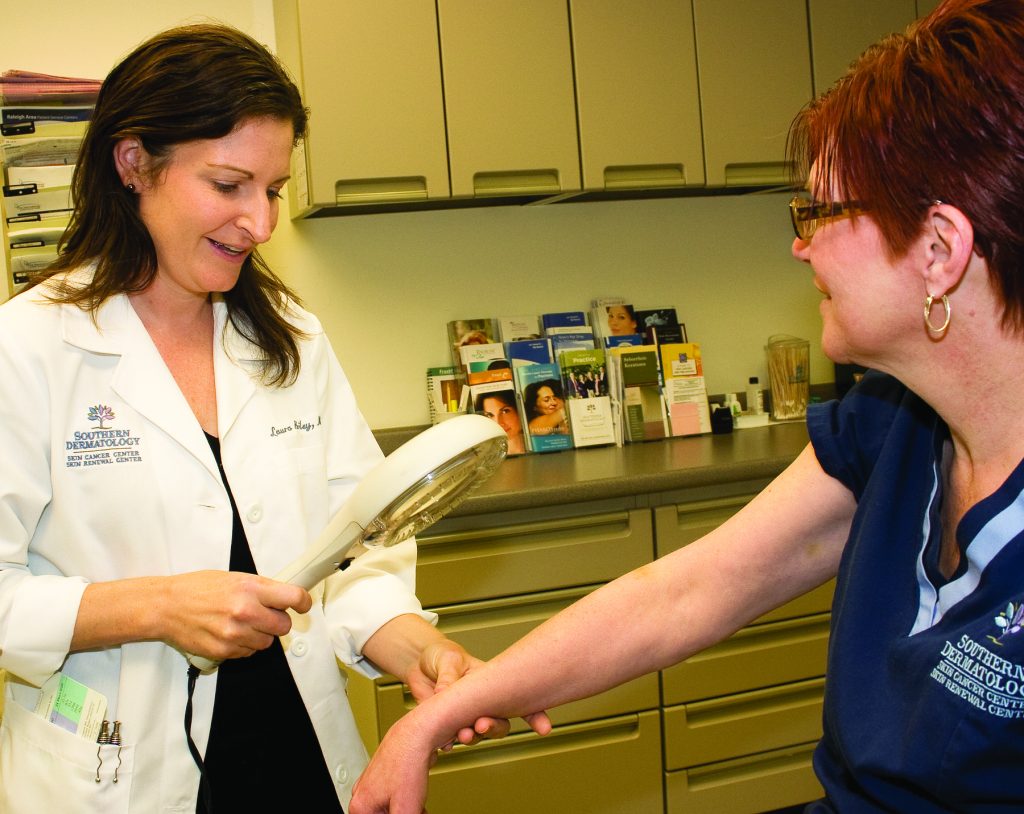
“Quality of life.” It is a phrase that describes the goal all medical providers work towards as they examine and assess, evaluate, and treat. And one of the biggest factors affecting quality of life, not surprisingly, is the experience of pain. But pain, as Dr. Laura Briley of Southern Dermatology and Skin Cancer Center in Raleigh knows, comes in many forms.
“The unique challenge we confront as dermatologists,” she observes, “is that, for most skin diseases, everything’s on the surface. The majority of the common conditions we treat—such as eczema, psoriasis, and acne—are visible, often in painfully embarrassing ways.
“Because of their visibility, there’s a huge psychological component to these diseases. So, although they may not be life threatening or cause physical pain, they can be life altering. Living with the impact of these conditions can lead to depression, social isolation, and mental anguish that can have a really negative effect on quality of life.”
Eczema, says Dr. Briley, is a good example. “Eczema can be flagrantly bad all over your face and arms. You’re itchy and miserable and have trouble sleeping. But, on top of that, your skin is weeping and crusting, and you think ‘I don’t want to go out in public looking like this!’ It’s depressing and embarrassing.
Shingles:
Rashes, Blisters, and Pain
“Fortunately, relatively few skin diseases produce really severe pain,” says Dr. Briley. “A notable exception is shingles, or herpes zoster. And, while the symptoms vary, nerve pain from shingles can be excruciating, and can last months—or even years.”
Shingles is not a rare problem, notes Dr. Briley. “Nearly one out of every three adults will develop shingles in their lifetime, and the risk increases with age. About half of all cases occur in men and women age 60 years and older.
“Everyone who has had chickenpox (over 90 percent of us) has the potential to develop shingles,” she explains. “It’s caused by the same virus that causes chickenpox, and which remains in a dormant state in certain nerve cells of the body for months or many years. When the virus reactivates, it travels down one of the nerves onto the skin where the virus can then reproduce in the skin and along that nerve—which is why it produces blisters and pain in various places on the body.”
Although we know where shingles comes from, notes Dr. Briley, “what we don’t know is what prompts the dormant virus to reactivate. People with more severe episodes of shingles tend to be older, and it’s likely that those with weakened immune systems are more susceptible; stress also may play a part. But the exact trigger is unclear.”
In terms of treating shingles, says Dr. Briley, “it’s important to treat it early—within the first 72 hours or so. If we catch shingles early, antiviral medication will decrease the severity of the episode, and we have a number of medicines—such as gabapentin or Lyrica—that are very effective in treating nerve pain. “Vaccines,” she adds, “are also important in preventing shingles or at least mitigating shingles pain, and we recommend that everyone over 50 get the shingles vaccine.”
“That is equally true of psoriasis and acne. Severe plaque psoriasis, for example, is an autoimmune disease that presents as scaly skin lesions that may cover as much as 90 percent of the body. And it can have a profound psychological effect as well as a physical one. Patients often limit activities to avoid being seen. And studies have found that people with psoriasis tend to have lowered self-confidence and experience higher rates of anxiety and depression.
“One of the most significant features of these diseases,” adds Dr. Briley, “is that they are exacerbated by stress. And their visibility is a source of stress; it’s a vicious cycle.”
Hair Loss, Pigmentation Issues
High-visibility diseases aren’t limited to those producing rashes and plaques, notes Dr. Briley. “And diseases involving hair loss or pigmentation issues can be heartbreakingly difficult to live with.
“Vitiligo, for example, is a chronic autoimmune disorder that causes patches of skin to lose pigment or color; these vary in size and can appear anywhere on the body. This can be extremely difficult, especially for those with darker skin. Those with lighter skins can try to hide it—by not getting tan. But for people with darker skins, a total loss of pigment results in a bright white patch. And the darker you are, the more noticeable it is. Furthermore, the face and hands are involved, so it’s impossible to hide.
“It’s a challenging condition to treat,” she adds. “We’ve had more success with Opzelura, a recently approved medication, than with topical steroids, but there’s nothing that works quickly, and it can be years to recover pigment.”
In contrast, notes Dr. Briley, “for those dealing with the melasma—the reverse problem of hyperpigmentation—there are a number of treatment options. This condition, often triggered by hormones, results in the development of dark brown or grayish-brown patches, and these can be addressed with lightening agents, chemical peels, or lasers.”
Diseases involving hair loss can also be stressful and emotionally painful, as well as a challenge to treat, says Dr. Briley. “Alopecia areata is one example. This is an autoimmune disease that attacks your body’s hair follicles, causing your hair to fall out in patches. The patches are usually small and round, but some patients—such as a patient I’ll call Suzy—have a version of the disease called alopecia areata universalis where they lose all the hair on their bodies, including their eyebrows and eyelashes.
“Suzy, who’s now 25, hadn’t had any hair on her body since she was 12—none. And you can imagine how difficult that was to go through adolescence without hair, eyebrows, or eyelashes. A bald head can be wrapped and hidden; you can’t hide the lack of eyelashes and eyebrows.
“The really exciting news is that, thanks to a new class of medications called JAK inhibitors, we now are able to provide treatment—even in such extreme cases.”
Medications That Transform Lives
“The common denominator in many of these skin diseases,” notes Dr. Briley, “is that they are autoimmune diseases. If you have an autoimmune disease, your immune system is hyperactive, and attacks not only invading viruses or bacteria, but your own healthy tissue. We know there is a genetic component to these diseases, but a variety of factors contribute to them.
“What’s particularly problematic is that an autoimmune disease is a chronic condition,” she explains. “This means you’ll probably have to manage it and the symptoms it causes for the rest of your life. And, until quite recently, one of the greatest challenges in treating these diseases was to do so safely over the long-term. Twenty years ago, we had only a handful of therapeutic interventions, and many of them toxic or inconvenient.
“Today, that has all changed thanks to the development of biologic medications,” she explains. “Rather than treating a condition systemically, these medications target specific parts of the immune system, significantly reducing adverse side effects.
“In addition, new biologic drugs continue to come out every year, giving even more opportunity for patient-specific treatment, There are unique classes of them, depending on what pathway they suppress, and we can target the medication to the specific patient in a way that was simply not possible with the older meds.”
“Suzy, my 25-year-old patient with alopecia areata universalis, is a dramatic example,” says Dr. Briley. “One of the newer medications approved about a year ago—in a class called JAK inhibitors—is called Olumiant®. We started Suzy on that medication last year and, within three months, she had a full set of eyebrows and eyelashes, and she was growing a few hairs on her head. Over the next six to eight months, she regained probably 60 percent of her scalp hair and complained that she had to start shaving her legs! Remember: she had had no hair anywhere on her body since the age of 12!
“This is a chronic condition and will require her to continue on the medication. She came off it briefly and her hair growth declined, but now that she’s back on the medication she has regained about 80 of her scalp hair and it’s growing out. And, most important, she can continue to take this medication safely.
That combination of more effective, safer drugs has been transformational for so many patients with chronic conditions such as psoriasis and eczema. And now we even have FDA approved medications for vitiligo, which are showing real promise. “It’s a new era. And I must say that it’s great practicing in a time where you actually can give somebody a medication that’s going to work so well and safely.”