TMJ & Sleep Therapy Centre of Raleigh-Durham
For more information, contact:
Charles Ferzli, DDS, FAACP, DABCP, DABCDSM, DABDSM
TMJ & SLEEP THERAPY CENTRE OF RALEIGH-DURHAM
1150 NW Maynard Road, Suite 140
Cary, NC 27513
Telephone: (919) 400-7477
RaleighTMJandSleep@gmail.com
https://RaleighTMJandSleep.com
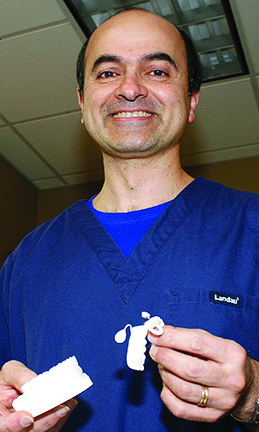
Pain is the driver that brings most patients to Dr. Charles Ferzli’s TMJ and Sleep Therapy Centre practice in Cary. But the nature of the pain is surprisingly varied. “That’s because these patients come to us seeking relief from symptoms of Temporomandibular Joint Disorder (TMJD),” explains Dr. Ferzli, “and those symptoms range widely—from severe jaw pain and limited range of motion, to headaches, to pain in arms, legs, hands, and feet, even tinnitus.
“In fact, TMJD,” he notes, “has been called ‘the great imposter,’ as the pain is not always concentrated in the jaw. And, consequently, our patients often come here after unsuccessfully seeking symptom relief from many specialists.”
TMJD is rarely the result of a single problem, explains Dr. Ferzli. “Jaw joint problems are multifactorial, the result of a complex interplay of causes and effects. The initial source of the problem might be trauma to the jaw joint, and it’s also likely that problems develop in response to pain or injury elsewhere in the body. This is because of the central role the jaw joint plays in our everyday bodily functions.”
Health&Healing: How would you describe that role?
DR. FERZLI: The jaw joint is central because it involves all the functional motions of talking, swallowing, chewing, yawning, expressing emotion, even breathing. For example, we start swallowing in utero; and when we swallow, we are moving the joint. In fact, you can be completely still—not moving any other muscles—and swallowing and breathing will engage the TMJ.
Furthermore, the jaw joint is a critically important part of our body’s response to stress. When the body perceives stress—even low-level, chronic stress—the muscles around this joint often contract in response; we clench. That simple act of clenching one’s teeth is the body’s automatic response to pain and other stress, causing the release of hormones that calm the nervous system and relieve pain.
Clenching is a normal, automatic motor movement that’s a positive response to stress. Problems develop when clenching becomes excessive. There are many potential causes, including chronic pain, systemic inflammation, dental problems, severe emotional and mental stress. And often clenching is connected to sleep and breathing issues.
The Clenched Jaw
H&H: What is the connection to sleep problems?
DR. FERZLI: It’s a critically important connection, and explains why so many TMJD patients also have sleep apnea. If our airways are impaired, when we sleep, we will clench in order to get enough oxygen. Airways can be impaired by many structural issues. These include congestion from allergies, tongue tie, a deviated septum, excess weight, enlarged tonsils, or abnormal jaw, head, or neck issues. Breathing problems, such as mouth breathing, also contribute to disrupted sleep.
And this creates a vicious cycle.
There’s a reason that we spend a third of our lives sleeping. Because sleep—in all its stages—is essential for all aspects of our health, providing the foundation for healing, growth, and cognitive processing. When we don’t sleep, we don’t learn, we have trouble remembering things. We have more inflammation, we feel more pain, we’re more tired and irritable. We have more anxiety and suffer more from depression.
Most important, it’s during sleep that the body heals. But when sleep is interrupted by breathing problems, the stages of sleep that are critical to healing are disrupted. Our jaw joint will continue to respond to the stresses of pain and fatigue, and the clenching will continue to disrupt sleep.
Clenching, Breathing, and Sleeping
H&H: Besides structural issues, what other breathing issues are connected to sleep problems?
DR. FERZLI: Impaired airways are a serious problem interfering with healthy sleep. But how we breathe is also a critical factor. We’re designed to breathe through the nose, ensuring the most efficient oxygen/CO2 exchange, and optimum blood oxygen absorption. Nasal breathing also warms, humidifies, and filters the air we breathe.
Chronic mouth breathing, in contrast, is less efficient and can have a significant negative impact on health. Dental issues—such as gum disease or tooth decay—are commonly associated with mouth breathing, and it’s also a source of jaw issues. That’s because, since the tongue has to fall on the floor of the mouth to mouth breathe, the jaw may become crowded, decreasing air flow.
The biggest problem with mouth breathing is sleep impairment. Getting less oxygen to the tissues can elevate the heart rate and even cause an adrenaline surge during the night, waking people up. Sleep interruptions in turn reduce the necessary restoration that takes place during healthy sleep.
Furthermore, while nasal breathing doesn’t involve clenching, mouth breathing can cause people to clench and grind their teeth, a particular problem while they’re sleeping. That, in turn, can produce chronic jaw joint issues, headaches, or ear pain.
H&H: How big a problem is mouth breathing and what causes it?
DR. FERZLI: It’s estimated that 30 to 50 percent of people are chronic mouth breathers, and that the percentage is higher among children. There are many reasons why they develop the habit of mouth breathing. Nasal congestion from an allergy or illness, for example, might be the initial cause of a mouth breathing habit. Diets high in sugar and processed foods create excessive inflammation in the body, which leads to nasal congestion, frequently resulting in mouth breathing. Structural issues, including enlarged tonsils and adenoids, also cause mouth breathing. But the habit itself produces other problems. Everything is connected.
H&H: You indicated that this can be a more serious problem for children.
DR. FERZLI: It is. When children breathe through their mouths instead of their noses, it sets in motion a chain of reactions that increase the risk of many health problems. There’s a forward head posture that puts strain on the neck and back; that causes the jaw to drop, affecting the growth and development of the child’s dental arches, and changes the tongue position.
As a result, children develop a crowded mouth and are more prone to cavities because of dry mouth. That’s the beginning of jaw problems, because if they cannot breathe through the nose, they’ll clench their teeth while sleeping. If children are not well-ventilated during sleep, it can affect their growth and development, their cognitive functions and skills will be affected, and their IQ level can be affected.
Additionally, when children don’t sleep well their nervous system is in a fight-or-flight state. This can result in hyperactivity and attention problems. So it’s not uncommon for them to be misdiagnosed as having only attention deficit problems, when they may also have serious sleep and airway problems. And, unfortunately, rather than being treated for the sleep problems causing attention issues, these children are treated with stimulants for ADD or ADHD.
The Healing Path
H&H: The complexity of TMJD that you describe suggests a steady negative spiral of pain; how do you unwind it?
DR. FERZLI: Since there’s no singular cause to these problems, there’s no single “cure.” But healing can happen.
The path begins with testing. We need to fully understand the nature and sources of breathing and jaw pain problems. And we employ a wide variety of tools—from questionnaires and X-rays to breathing tests and sleep studies—that allow us to accurately pinpoint all issues involved.
Testing reveals structural and medical issues that require attention—perhaps from a physical therapist, or ENT physician; surgery may even be necessary. But, even as these options are pursued, our first step is immediate pain relief. We do this with the use of oral appliances that reposition the jaw so it is relaxed, keeps airways open, and prevents clenching.
At this stage we are treating symptoms, without changing the physical structure of the jaw—that may come later. But symptom relief is immediate. By using the appliances, we decompress the joint, reduce inflammation, relieve pain, and allow the joint to heal. Most important, we improve sleep quality by preventing the airway from collapsing while sleeping.
Daytime appliances serve similar role, but the critical importance of an appliance at night is to protect sleep. The goal: fully oxygenated sleep through all cycles, allowing healing, restoration.
The next steps are to identify specific issues: Are they mouth breathers? Do they have allergies? Are there structural issues, such as tongue tie? Are they dealing with sleep apnea or upper airway resistance (UARS)?
The answers to those questions form the basis of a plan to guide the healing process. We have tools, including oral appliances and LED light therapy to relieve pain and support healing, but the critically important part of the process is education. The evaluations make it possible to understand the problem—not only the source of the pain, but the other factors that exacerbate it and prevent healing. And this information is shared with the patient. At this point healing is, to a great extent, up to the patient. We can identify the sources of their problems, but they have to make the choices. And many of the contributing factors are, in fact, lifestyle choices—eating well, drinking water, exercising, breathing and sleeping habits. If the patient is ready, that’s when healing takes place.