Cynthia Gregg
Face & Body Specialists
For more information about the practice, contact:
CYNTHIA GREGG, MD, FACS
FACE & BODY SPECIALISTS
Cynthia Gregg, MD, FACS
3550 NW Cary Parkway
Suite 100
Cary, NC 27513
Telephone: (919) 297-0097
https://cynthiagreggmd.com

Ask anyone who has surfed the net, consulted Dr. Google, or engaged with social media; the options for facial rejuvenation are innumerable. Products and procedures promise to reduce wrinkles, lift drooping eyelids and sagging jowls, and eliminate a “turkey neck” or bags under the eyes. Options range from surgical face lifts to fillers and laser treatments.
“The information can be overwhelming,” acknowledges Cary plastic surgeon Cynthia Gregg, “and making sense of it all is a challenge. The simple truth is that today we have an exceptionally rich collection of tools and products to address issues of aging. But the ‘right’ approach is a very individual thing.
“The aging process affects us all,” she explains. “The very shape of our face changes, moving downward and inward. It happens in stages, starting at about age 30. It’s a gradual process of loss. We lose the skin’s collagen, elastin, and ability to hold hydration; we also lose muscle, fat, and—eventually—bone. When you add gravity, the result is drooping skin, flattened cheeks, sagging jawlines, and double chins. The rate at which this happens and what goes first is individualized and largely genetic,” she adds, “but eventually it happens to us all.”
Understanding that process, explains Dr. Gregg, “allows us to reverse it—to turn back the clock in many ways. We can replace lost collagen and hydrate and tighten drooping skin, repair sun damage, and fill and lift to replace lost tissue. But, like aging itself, rejuvenation is not a single event, but a process—a response at different times to the changes experienced by each individual patient.
A Special Offer to
Enhance Summer Skin
“Radiesse® and Radiesse® (+) injections,” explains Dr. Gregg, “are among the many new tools we use to address issues of aging skin. Radiesse® is one of the leading dermal fillers in the world because it not only improves the appearance of facial folds and wrinkles, but it also stimulates collagen production. Radiesse®(+) is the basic product with Lidocaine added for comfort during the injection process.
“Radiesse®,” says Dr. Gregg, “is FDA approved for the correction of moderate to severe wrinkles and folds, and is also effective in providing volume to the backs of aging hands. And, in a hyperdiluted form, it is ideally suited as a treatment for exposed summertime skin, as it targets crepey skin on the arms, legs, and décolletage.
“For that reason, we are offering a summer special in June and July. Purchase a series of two treatments* of Hyperdilute Radiesse® and receive a complimentary full-sized Alastin® TransFORM body Treatment with TriHex Technology®** to augment your results.
“With only two treatments with Hyperdilute Radiesse®, you can lift and tighten crepey skin by stimulating the building of new collagen and elastin. Alastin® TransFORM also helps to reduce crepiness and rebuild your elastin—a combination that provides the best possible results. The treatment is effective for hands, arms, knees, chest, and neck.
“The special is available through July 31, while supplies last. To make an appointment with one of our experienced nurse injectors, call our office at 919-297-0097, and mention code: H&HRadiesse.
*Both syringes must be used at the same visit; discounted gift cards may not be used for purchase
**A $220 value
“Finding the right response is part of the art of rejuvenation,” she says. “And the right response involves both balancing the personal needs and goals of the patient and the range of options available. We offer what I like to call a rich buffet of products and procedures from skin care to surgery. The ‘right’ choices are unique for each patient.”
In a conversation with Health&Healing, Dr. Gregg describes the process of finding the right rejuvenation path for each patient.
The “Right” Approach
Health&Healing: What is that process like? Where do you begin?
DR. GREGG: One of the most important tools in my work—perhaps the most important—is the consultation process; and the first step in that process is to hear from the patient. I need to know what brings them to me. I don’t ask what procedure they want; I hand them a mirror and ask “what bothers you?”
Very often what bothers them and what procedure they think they need are quite different. That is why the consultation process is so important. They know what they want to change; I’m there to explain how that change can occur.
Because of the tremendous influence of social media in our lives today, it’s not uncommon for a patient to come in not only with an image in their mind of the results they are seeking but a firm opinion about what procedure is needed. What they don’t appreciate is that the social media image they admire is misleading. Not only is it likely enhanced and altered, but it cannot reflect their own anatomy or aesthetic goals. Nor do they understand the range of options available to accomplish their goals.
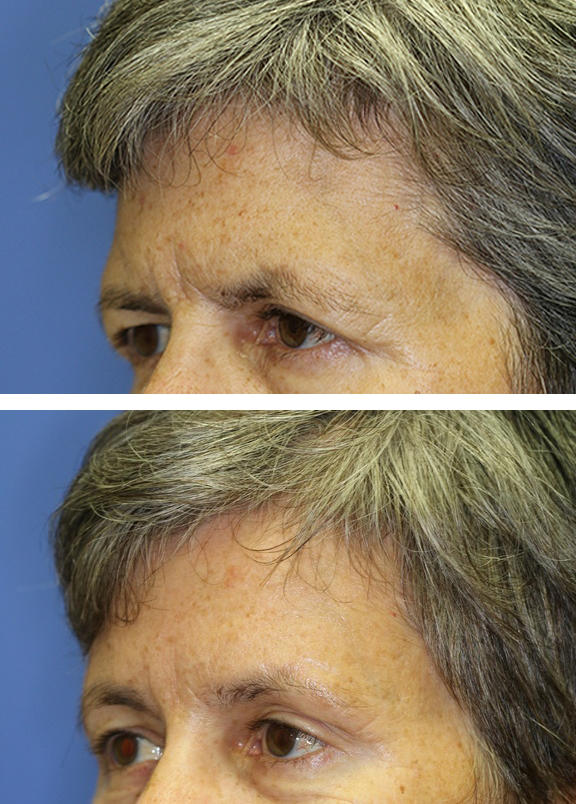
A typical example of that situation is the patient who comes into seeking eyelid surgery. They don’t like their drooping upper eyelids, and assume that they need eyelid surgery to remove the excess skin. Well, that may be true; but it may not be the right option.
I’ll certainly want to solve their problem. But I’ll take into consideration their whole anatomy. I’ll start from the hairline and look at their skin and tissues all the way down to the upper eyelid lash line—because it’s all related. And, not infrequently, drooping eyelids are not the problem; the real culprit is a sagging forehead. By lifting the brow, the eyelid problem is resolved. (see photo, left)
For those patients, we have to come back to that critically important question: “what bothers you?” From there, we can find a solution for that specific patient. There are usually many options for doing so—both surgical and non-surgical. The choices are influenced by their anatomy, surgical limitations, skin texture, and many more things. My job is to help them understand what can be done and what can’t; always keeping in mind what they want to accomplish.
“Hemming” and “Ironing”
H&H: How do you determine whether to use surgery or non-surgical methods?
DR. GREGG: I’ve found it useful to use a sewing analogy when explaining this to my patients. I describe it as a question of ‘hemming’ versus ‘ironing.’ If you bring me a pair of pants that are too long and wrinkled, do I hem them or do I iron them? If there’s nothing for me to hem—in other words, if there’s no laxity that I need to lift—nothing I can do surgically will fix the problem. We then turn to non-surgical options to ‘iron’ the wrinkles.
However, I’ll also explain to them that, in five or ten years, there may be a lot of skin or muscle laxity, and I can go in and surgically lift or remove it to achieve the desired result. Surgery would then be an appropriate choice.
I should note that to my “hemming” and “ironing” analogy, we probably need to add “mending.” Rejuvenation is often a matter of repairing the damage that comes with age. And one of the most exciting aspects of my work has been the extraordinary expansion of new products and techniques for facial rejuvenation.
H&H: What has changed and what new options are available?
DR. GREGG: In the early years of my career, options were much more limited and typically restricted to surgical procedures. Today, we’re able to offer our patients what I like to call a ‘buffet’ of options—many of them non-surgical, and all of them improved methods of providing facial rejuvenation.
Without surgery, we can lift and fill changing faces, erase wrinkles, and rejuvenate skin. Techniques including microneedling, chemical peels, and lasers are used to improve and repair skin texture and tone, soften wrinkles, eliminate brown spots, and correct sun damage and broken blood vessels. And what is especially important, these products and procedures allow rejuvenation in a most natural way.
More recently, advancements in regenerative medicine have added remarkable new tools for rejuvenation. One example is Platelet-Derived Growth Factor (PDGF), a powerful compound that plays a pivotal role in skin repair and rejuvenation. PDGF is a naturally occurring protein found in platelets and various other cells. It is one of the primary growth factors responsible for wound healing, tissue repair, and cellular regeneration.
And we are finding that it is a powerful new tool for rejuvenation. It’s considered a “biostimulant”—stimulating our body’s natural healing and growth functions. We use it to boost the effectiveness of a variety of techniques. For example, when used in microneedling or laser procedures it increases the growth of collagen and elastin fibers by as much as 250 percent, and also dramatically increases the development of one’s own hyaluronic acid. Using PDGF can help in enhancing skin texture and tone, reduce fine lines and wrinkles, and accelerate healing and recovery from surgery.